Traditional lawns can look like the default choice, but climate-resilient gardens are changing what “normal” needs to do in a British front or back garden. Sustainable landscaping focuses on saving water, reducing chemicals, and coping with heat, drought, and sudden downpours-all things a classic grass rectangle wasn’t designed for. If your lawn keeps going patchy, boggy, or high-maintenance, it’s not you being fussy. It’s the system showing its limits.
The quiet truth is that lawns only look effortless when the weather behaves and resources are plentiful. Future-focused gardens assume the opposite: more extremes, more scrutiny on water use, and less appetite for weekly inputs just to keep one surface green.
The lawn’s “perfect conditions” are getting rarer
A traditional lawn thrives in a narrow comfort zone: regular rain, mild temperatures, and a soil structure that drains evenly but doesn’t dry out. That was never guaranteed in the UK, but it’s becoming less dependable as summers run hotter and dry spells last longer. Then, when the rain does arrive, it tends to arrive in a rush.
This whiplash matters because grass has shallow roots compared with many garden plants. Shallow roots are first to dry out in a heatwave and first to suffocate when heavy rain sits on compacted ground.
A lawn isn’t fragile because it’s “just grass”. It’s fragile because it’s asked to stay uniformly green through conditions that are no longer uniform.
The modern lawn problem in one line
It’s a high-input surface pretending to be a low-input one.
Lawns push you towards inputs you may not want
There’s a reason lawn care advice starts to sound like a routine: feed, weed, mow, water, repeat. Those steps can be fine in moderation, but they clash with the direction most people want their gardens to go-lower maintenance, lower costs, fewer chemicals, more wildlife.
In practice, lawns often nudge you into:
- More watering in dry spells, just to prevent dormancy and bare patches
- More fertiliser to chase colour and density after stress
- More herbicide to “tidy up” the weeds that move in when grass thins
- More mowing during growth spurts, which removes clippings (nutrients) unless you mulch
Each input becomes a response to the last problem, and the problems multiply when the weather swings.
Compaction: the invisible reason lawns fail
Most struggling lawns aren’t failing because the seed mix is wrong. They’re failing because the ground underneath is tired.
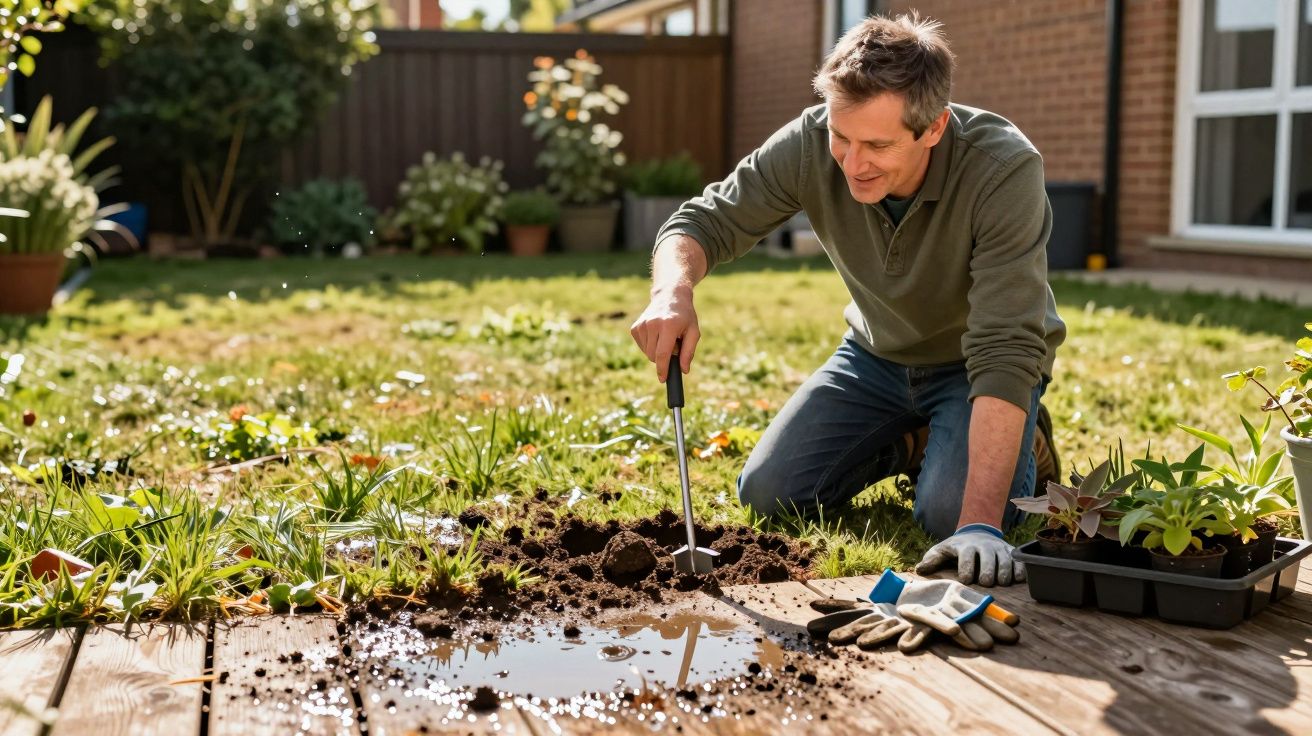
Compaction builds up from foot traffic, kids playing, pets running the same line, and even repeated mowing. Soil pores collapse, oxygen drops, and water can’t move properly. In a drought, compacted soil turns hard and sheds water. In a downpour, it turns slick and saturated.
If you’ve ever seen water sit on your lawn like it’s on a patio, that’s not “just heavy clay”. That’s a drainage pathway that’s been pressed closed.
A quick check you can do today
Push a screwdriver into the lawn after rain and again after a dry spell. If it’s hard work both times, you’ve got compaction plus poor infiltration-grass will always struggle there without soil work.
Biodiversity: lawns are tidy, but they’re also quiet
A closely mown lawn is a green carpet with very few flowers, seeds, or places to shelter. That’s part of its look, but it’s also its ecological limitation.
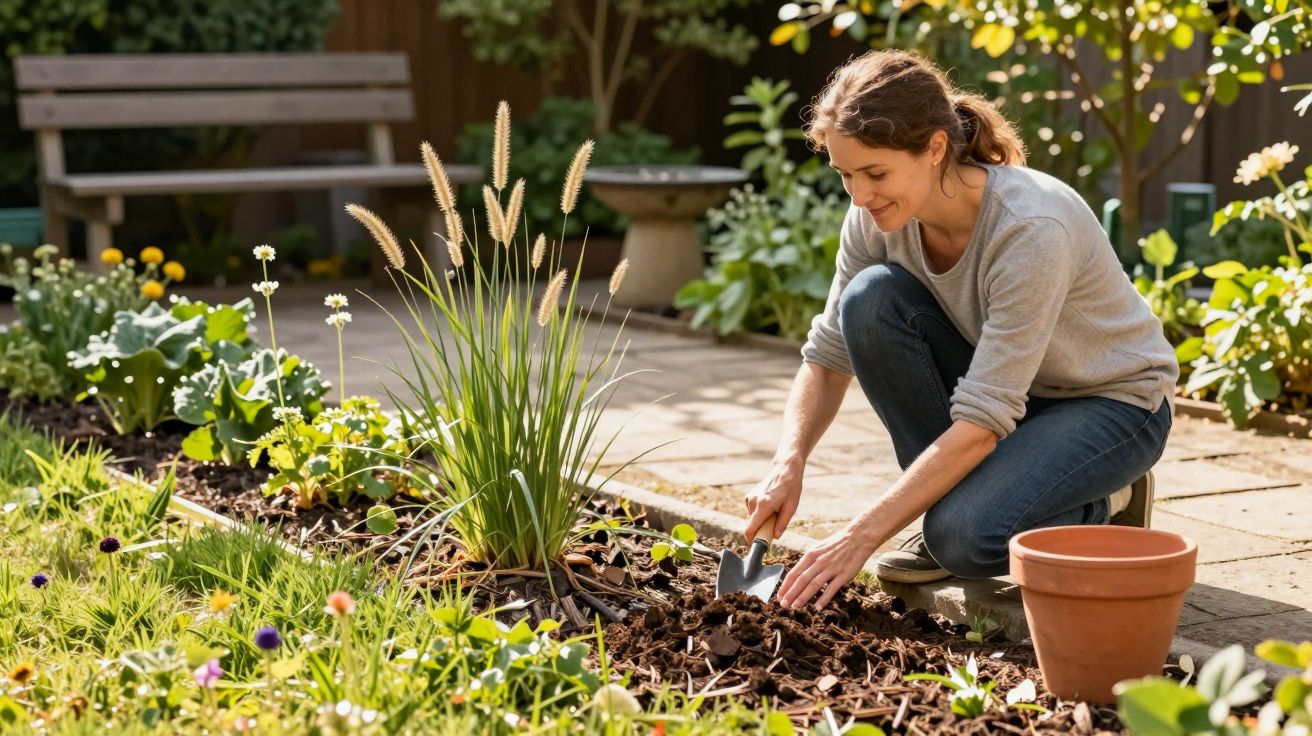
Future-focused gardens tend to swap some of that uniformity for layers: flowering groundcover, shrubs, perennials, and areas left to grow a little taller. The payoff is not just “more bees”. It’s a garden that performs better-cooler in summer, better at handling rain, and more resilient when one patch fails.
A lawn can still have a place, but when it dominates the whole space, it tends to dominate your time and budget too.
Why lawns struggle in climate-resilient gardens specifically
Climate-resilient gardens aren’t only about surviving drought. They’re about absorbing extremes without constant intervention. That usually means deeper roots, more varied planting, and surfaces that let water in rather than sending it off the plot.
Lawns struggle because they’re optimised for appearance, not performance. They don’t shade soil well when cut short, they don’t store much moisture at root level, and they don’t recover quickly when stress hits repeatedly. A mixed planting bed, by contrast, can lose one plant and still look fine; a lawn tends to show every weak point at once.
What to do instead (without turning your garden into a “project”)
You don’t have to rip out all the grass to move towards sustainable landscaping. The most successful changes are usually targeted: keep grass where you use it, and upgrade the rest.
Here are practical swaps that suit UK gardens:
- Reduce lawn area and widen borders for drought-tolerant perennials and shrubs
- Create a “functional lawn” (play, sitting, paths) and let the rest become meadow or groundcover
- Use mulch and planting density to shade soil and reduce evaporation
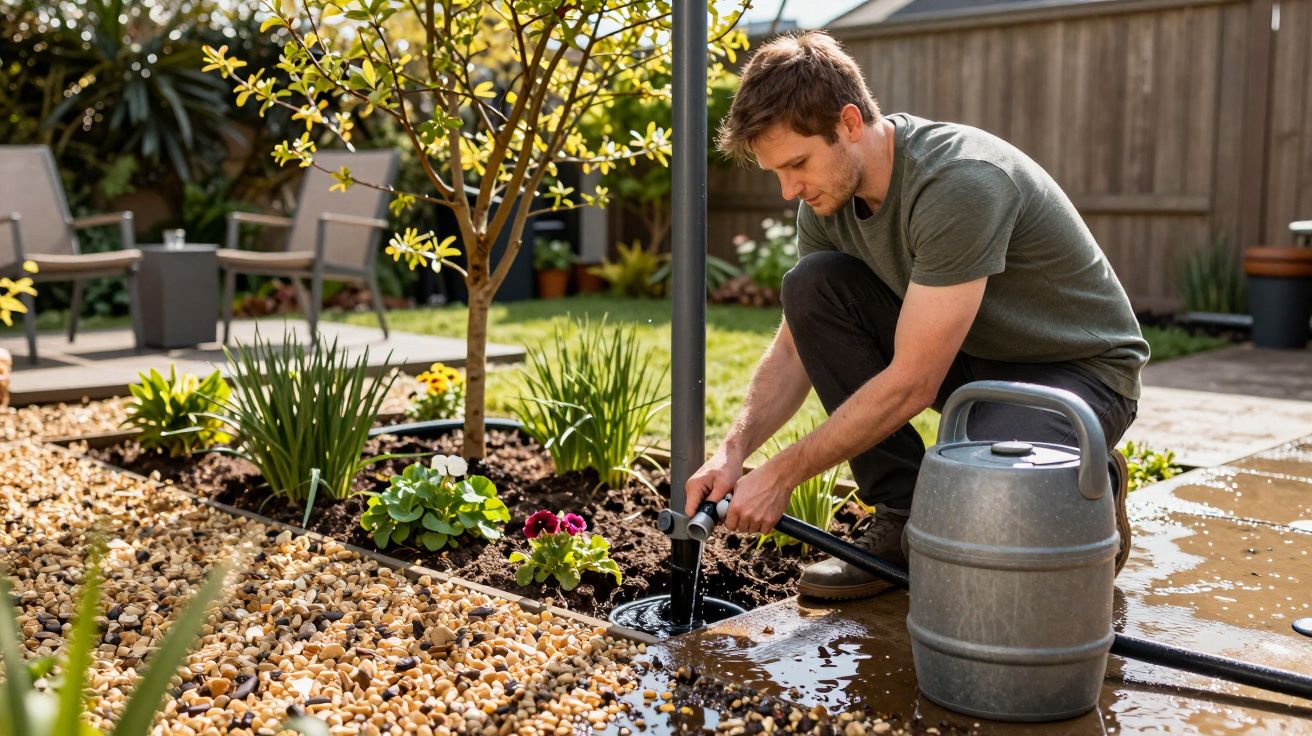
- Add rain-capture features such as water butts, swales, or a small rain garden in a natural low spot
- Choose alternative surfaces (gravel with planting, permeable paving) where grass always fails
If you want one simple rule
Keep lawn only where it earns its keep.
A fast “diagnose and decide” guide
Before you change anything, separate a lawn problem into the part you can fix and the part you’re fighting.
| Symptom | Likely cause | Better long-term move |
|---|---|---|
| Patchy and brown every summer | Shallow roots + heat/drought | Reduce area, switch to deeper-rooted planting nearby |
| Moss and soggy patches | Compaction + shade + poor drainage | Aerate, improve soil, or convert to shade planting |
| Weeds taking over | Thin grass from stress | Thicker sward helps, but often needs less lawn and more planting |
The point isn’t to “ban lawns”-it’s to make them realistic
A small, healthy lawn can be a brilliant part of a garden: barefoot space, visual calm, somewhere to sit. The trouble starts when we treat it as the default surface everywhere, even where it’s clearly unhappy.
Future-focused gardens are simply more honest about what each square metre needs to do. If climate-resilient gardens are the goal, the winning move is usually not perfect grass. It’s a layout that needs less rescuing in the first place.
FAQ:
- Is a brown lawn in summer a sign it’s dying? Not always. Grass can go dormant in drought and recover, but repeated stress plus compaction often leads to thinning and bare patches.
- Do I need to remove my whole lawn to be more sustainable? No. Start by shrinking it: keep grass for play and access, and convert the least successful areas to beds, groundcover, or permeable surfaces.
- What’s the most common fix people miss? Soil condition. Aeration and organic matter can do more for a struggling lawn than another round of feed or overseeding.



Comments (0)
No comments yet. Be the first to comment!
Leave a Comment