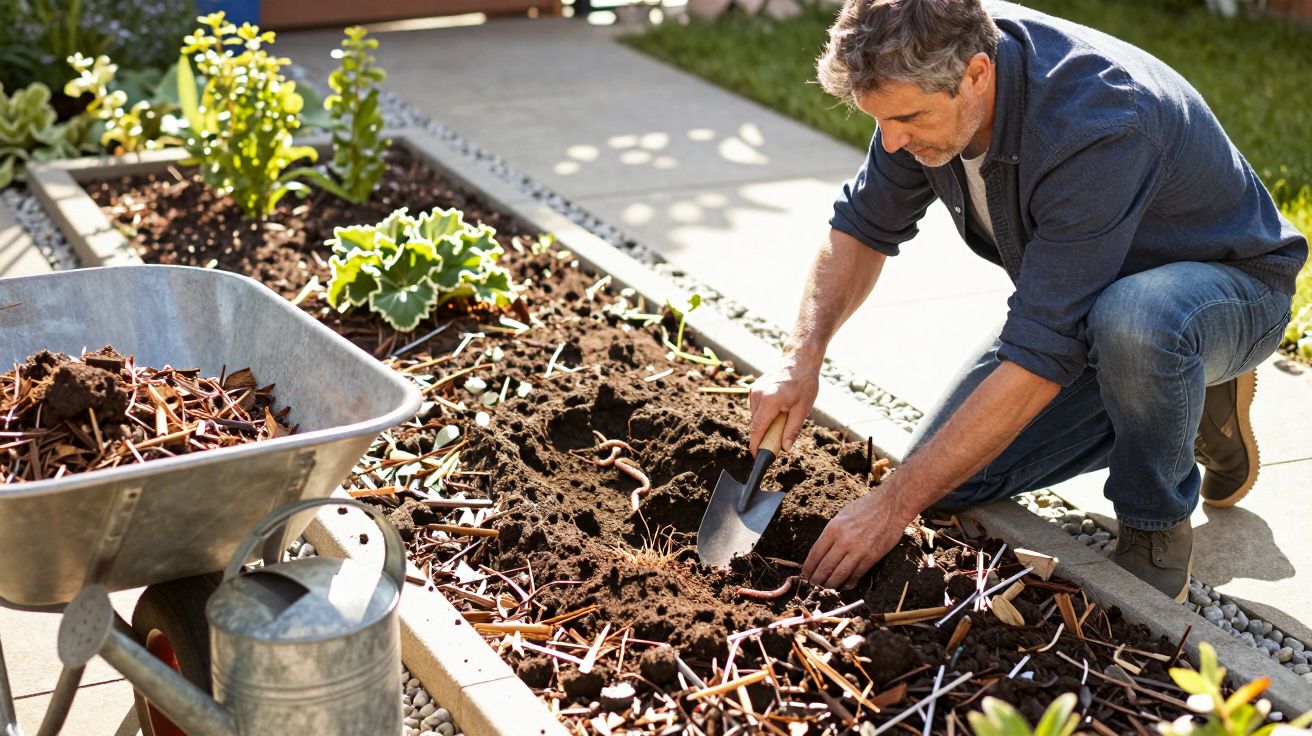
Most people start eco gardening by shopping for plants. Soil regeneration asks you to start somewhere less photogenic: underfoot, where sustainable landscaping either works quietly for decades or fails in a season. If you’re trying to cut watering, reduce inputs, and grow healthier plants with fewer problems, your real “design material” isn’t lavender or grasses-it’s living soil.
Walk through two gardens in summer and they can look identical from the gate. Come back after a dry spell, a hard winter, or a week of heavy rain, and you’ll see which one was built on looks, and which one was built on function.
The eco garden myth: plants as the main event
Garden centres sell the idea that an eco garden is a palette: natives, pollinator-friendly flowers, a wildlife pond, a few architectural grasses. Those things can help, but they’re the visible layer of a system that either cycles nutrients well or constantly begs for help.
The uncomfortable truth is that you can plant “all the right plants” into exhausted ground and still end up with mildew, stunted growth, constant watering, and a garden that only behaves when you prop it up with bags and bottles.
Soil doesn’t just hold plants in place. It decides how water moves, how nutrients are shared, how roots breathe, and whether your garden can buffer stress without your intervention.
What soil regeneration actually means (and why it changes everything)
Soil regeneration is the practice of rebuilding soil structure, carbon, and biology so the ground functions more like a living sponge than an inert potting medium. In an eco garden, that function is the difference between “low maintenance” as a promise and “low maintenance” as a reality.
Think of it less as “feeding plants” and more as restoring processes:
- Aggregation: crumbs and pores that let water infiltrate rather than run off.
- Carbon storage: organic matter that holds nutrients and moisture.
- Soil biology: bacteria, fungi, worms and microfauna that recycle fertility.
- Root depth: plants that explore downwards because the soil lets them.
When these processes are working, sustainable landscaping becomes simpler. You’re not constantly correcting the site; the site starts correcting itself.
The quiet indicator most gardens miss: how water behaves
If you want a fast diagnosis, don’t start with what’s flowering. Watch what happens in rain.
Healthy, regenerating soil takes water in. Compacted or depleted soil sheds it, puddles it, or funnels it into drains, taking fine particles and nutrients with it. That’s not just a drainage problem; it’s a resilience problem.
A useful home test is brutally ordinary. After a decent shower, can you push a trowel in easily? Does the surface crust? Do worms appear under mulch? If the ground feels like brick in winter and dust in summer, you’re looking at structure loss, not a “wrong plant” issue.
The three habits that wreck soil (even in “wildlife-friendly” gardens)
You can do everything else right and still sabotage soil regeneration with a few common routines.
1) Bare soil as a default look
Bare soil is an invitation to erosion, temperature swings, and moisture loss. Nature covers ground for a reason; exposed soil is a stressed soil.
2) Constant digging and turning
Occasional planting holes are fine. Repeated cultivation breaks fungal networks, collapses aggregates, and can speed up carbon loss. It also brings dormant weed seeds up like you’ve requested them.
3) High-nitrogen quick fixes
Fast feeds can push soft growth and short-term colour, but they can also reduce the plant’s incentive to trade with soil microbes. Over time, the system becomes input-dependent: feed, water, repeat.
None of this makes someone a “bad gardener”. It just explains why two gardens with the same plants can behave so differently.
A regeneration-first approach to sustainable landscaping
Designing with soil in mind shifts the order of operations. Instead of planting first and rescuing later, you set the conditions so plants can largely look after themselves.
Start by keeping the ground covered
Mulch is not decoration. It’s a climate layer for the soil.
- Leaf mould, compost, or well-rotted woodchip reduce evaporation and moderate temperature.
- A 5–8 cm layer is often enough to change how soil feels within a season.
- Keep mulch slightly back from stems to avoid rot and slug hotels.
Add organic matter, but don’t smother the system
Compost is a soil amendment, not a substitute for soil. A thin annual top-dressing works better than burying layers and endlessly “improving” with disruption.
Use plants as tools, not trophies
Deep-rooting perennials, grasses, and ground covers can be selected for what they do below ground: opening channels, feeding fungi, holding soil together.
A simple way to think about it:
- Ground cover for protection (shade the soil, suppress weeds).
- Deep roots for structure (create pores for air and water).
- Long-lived perennials for stability (less disturbance over time).
The “looks messy” problem (and how to solve it without compromising)
Regenerative gardens often fail socially before they fail horticulturally. Neighbours, clients, or even your own eye can read mulch, seed heads, and leaf litter as neglect.
You don’t have to choose between ecological function and clarity. Give the garden cues of intention:
- Mown or gravel edges around “wilder” beds
- Repeated clumps of the same plant to create rhythm
- A clean path line through softer planting
- One or two sculptural elements (a bench, a boulder, a small tree) as anchors
It’s the same principle good sustainable landscaping uses everywhere: make the system legible, so people trust it.
How to know you’re regenerating, not just gardening nicely
Progress isn’t measured by how many plants survived the season. It shows up in the background metrics-often quietly.
Look for these shifts over time:
- Water soaks in faster and the soil stays moist longer between rain.
- Weeding gets easier because seedlings can’t colonise a shaded, mulched surface as readily.
- Plants become less “needy”: fewer wilting episodes, fewer pest spirals.
- You see more soil life-worms, beetles, fungal threads in mulch.
If you’re buying fewer amendments each year, you’re on the right trajectory. If you’re buying more, the garden is telling you it’s not cycling well yet.
The point: plants are the decoration of a functioning system
Eco gardens are often judged by what’s blooming. But the garden that holds up-through drought, downpours, heat spikes, and your own busy weeks-is usually the one built around soil regeneration.
Get the soil processes moving, and a surprising thing happens. The plant choices start to matter less, because the ground stops behaving like a problem you have to solve and starts behaving like an ally.






Comments (0)
No comments yet. Be the first to comment!
Leave a Comment