The patio is already planned, the new border marked out with string, and then a summer storm hits and shows you what the drawing missed. Water rushes off the paving, pools by the back door, and scours a neat channel through the gravel you just laid. This is why water-sensitive design has moved from “nice extra” to the thing that quietly decides where paths, beds and seating can realistically go, especially as climate change adaptation becomes part of everyday gardening rather than a policy phrase.
Most gardens don’t fail because people choose the wrong plants. They fail because water has nowhere calm to land, soak, slow or leave. When rainfall arrives in heavier bursts and dry spells stretch longer, the old layout logic-flat lawn, hard edge, one drain-starts to feel like a gamble.
The moment gardens stopped being “decor” and became drainage
There’s a particular kind of frustration: you’ve made the garden tidy, but the first downpour makes it look messy again. Soil splashes up the fence. Mulch floats. The stepping stones sink and tilt because the ground underneath is doing its own thing.
The change isn’t just “more rain”. It’s more intense rain, landing on more hard surfaces, in shorter windows. Water-sensitive design treats that water as a layout material, like timber or stone: you decide where it goes, how fast it moves, and what it does on the way.
A friend in Leeds learned this the expensive way. They widened the patio for a table, kept the garden level “to make mowing easy”, and ran a narrow channel drain along the back of the house. In the first autumn storm the drain choked with leaves, and the water took the only route left-straight into the lawn edge, turning it into a bog that never quite recovered. The fix wasn’t a bigger drain; it was a different shape of garden.
What water-sensitive design actually looks like on the ground
It rarely looks like a big engineering project. Done well, it looks like a garden that simply copes: puddles disappear, beds stay planted, and you stop tiptoeing around mud.
A practical water-sensitive layout usually combines three moves:
- Slow it: break up sheets of runoff with planting, gravel strips, or a tiny change in levels.
- Soak it: create places where water can infiltrate-rain gardens, swales, porous paving.
- Store it: keep a portion for later-water butts, underground tanks, even a small pond.
The key is that these aren’t add-ons. They affect where the patio sits, how wide the path can be, whether you choose decking or permeable pavers, and where you must not compact the ground with constant foot traffic.
Why layout decisions now start with flow, not furniture
The old starting point was often: “Where do we want to sit?” The new starting point is: “Where does water already go, and where is it trying to go?”
Walk your garden in the rain if you can. You’ll see the truth quickly: downpipes that gush, corners that stay dark and damp, a slope that sends water towards the house. Those observations become layout lines.
Common layout shifts people are making without even calling it “design”:
- Moving patios slightly away from the back wall and using a permeable edge strip (gravel or planting) as a buffer.
- Swapping a straight path for a gentle curve that follows contours, so water doesn’t race alongside it.
- Turning the lowest point of the garden into a rain garden bed instead of fighting to keep it lawn.
If your garden is small, this matters even more. A single square metre of impermeable paving can dump a surprising amount of water into one spot during a cloudburst. When that spot is the lawn edge by the shed, you get mud. When that spot is a planted soakaway area, you get growth.
A simple example: the downpipe that dictates everything
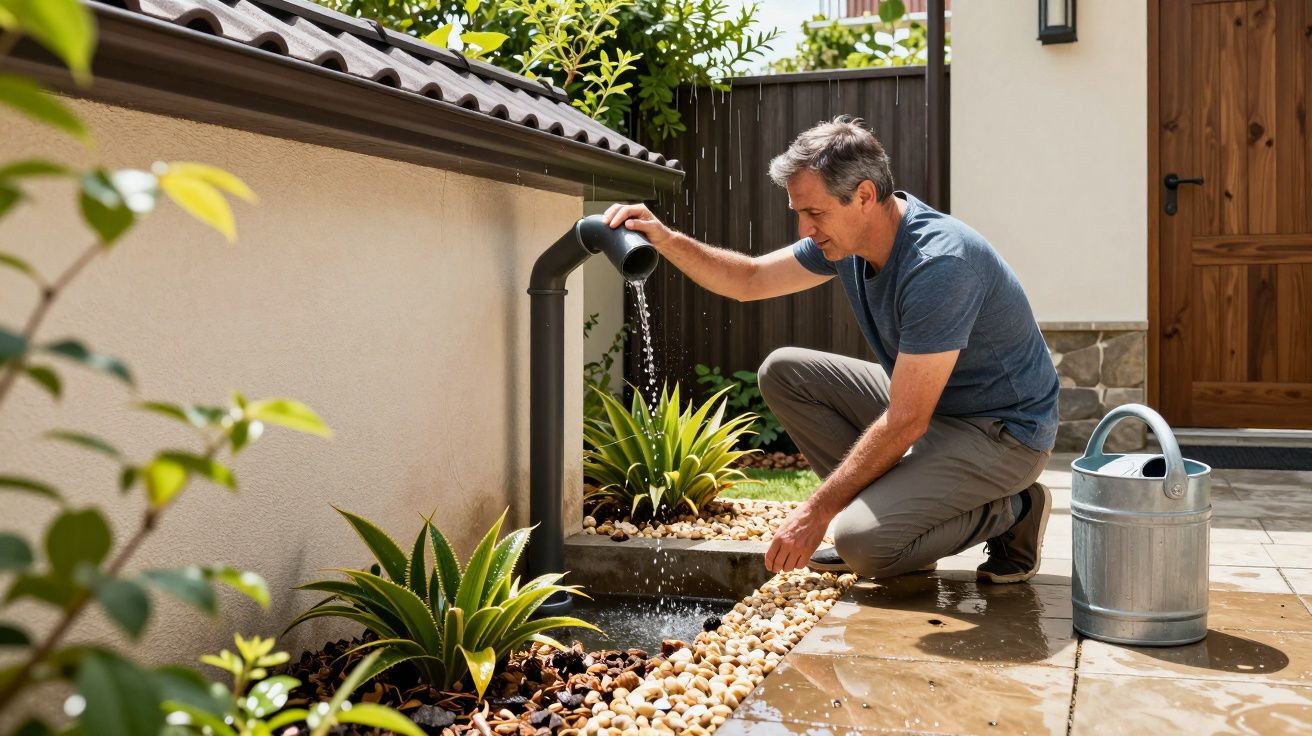
Most “mystery flooding” starts at the roof. One downpipe can deliver hundreds of litres in a storm, concentrated into a splash zone that compacts soil and bounces water back towards the house.
A water-sensitive approach might look like this: redirect the downpipe into a small rill or gravel runnel, let it spill into a shallow basin (a rain garden), and overflow safely to a second area in extreme rainfall. You haven’t just managed water; you’ve placed a feature, chosen a planting style, and decided where a path can’t go because it would become a stream.
Planting helps, but it’s not magic. The soil underneath has to accept water. Heavy clay can infiltrate slowly, so the basin needs more surface area, and the overflow route needs to be deliberate. Sandy soil drinks faster, so storage (like a butt) becomes more valuable for dry spells.
The quiet wins you feel all year
When rainwater management shapes the layout, you notice it in small moments. The compost area stays accessible without sinking to your ankles. The herb bed doesn’t get blasted by runoff from the patio. The lawn stops looking “tired” by July because you’ve kept more moisture in the ground, not just thrown more water at it.
There’s also a psychological relief in it. You stop treating weather as an enemy and start treating it as information: this corner wants shade and moisture, that edge wants a drainable planting mix, that slope wants a stepped path with pockets of planting to interrupt flow.
“The best gardens now don’t just look good in sunshine. They behave well in rain.”
A quick layout checklist before you build anything
Use this as a pre-plan, not a post-fix:
- Check where each downpipe discharges and whether it can feed a planted area or water butt.
- Aim for permeable surfaces wherever you can: gravel, resin-bound (installed correctly), permeable block paving, open-jointed stone.
- Keep a deliberate low point: a rain garden, wildlife pond edge, or soakaway zone.
- Avoid directing water towards the house; plan an overflow route for extreme storms.
- Protect soil structure: minimise compaction, and build beds with organic matter to improve infiltration.
| Choice | What it does | What you gain |
|---|---|---|
| Rain garden in the lowest spot | Captures and soaks stormwater | Fewer puddles, more resilient planting |
| Permeable path/patio edges | Breaks up runoff from hard surfaces | Less erosion, drier thresholds |
| Water butt linked to downpipe | Stores roof water for dry spells | Easier watering, less mains use |
FAQ:
- Do I need a rain garden if I already have drains? Often, yes. Drains move water away, but they don’t reduce the speed and volume hitting your garden, and they can overflow in heavy storms. A rain garden adds buffering and infiltration.
- Will a rain garden work in clay soil? It can, but it needs more surface area and a clear overflow route. Improving the soil with compost and choosing suitable plants helps, but don’t rely on soil improvement alone.
- Is permeable paving always better? Not always, but it’s usually beneficial where runoff is a problem. The key is correct installation: the sub-base and joints must be designed to let water through.
- What’s the first change to make on a tight budget? Start at the downpipes: fit a water butt and/or redirect discharge into a gravel strip or planted basin rather than onto paving or lawn edges.





Comments (0)
No comments yet. Be the first to comment!
Leave a Comment