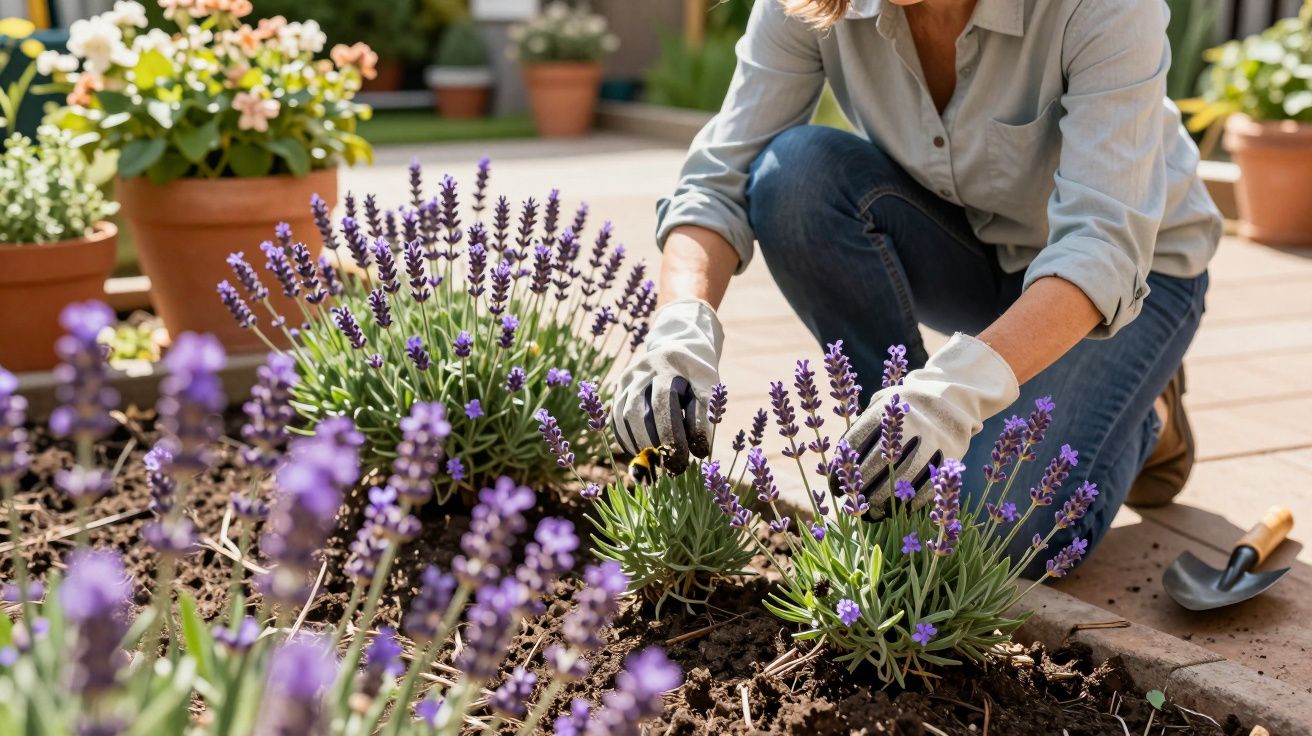
You plant a few pollinator plants in a neat repeating pattern, step back, and it looks… right. But in wildlife-friendly gardens, “right” isn’t always what gets noticed by a bee with a tiny fuel tank and a day’s worth of decisions to make. The way you group blooms can be the difference between a quick visit and a reliable daily route.
On a still afternoon, you can watch it happen. A bumblebee comes in low, hesitates, then commits-not to the whole border, but to one small pocket of colour. It works that patch hard, flower to flower, like it’s clocking in. Then it lifts off and vanishes, leaving the rest of your carefully spaced plants politely unvisited.
Why clusters are easier for insects to “read”
Pollinators don’t experience your garden as a design. They experience it as a landscape of signals: colour blocks, scent plumes, and the promise that the next flower won’t be a long, risky flight away. A single plant dotted here and there is like a sentence with the words spaced too far apart-you technically wrote it, but it’s hard to follow.
Clusters create a clearer target. A bigger patch of the same bloom reads as one loud message: food is here, and it’s worth it. That matters because many pollinators, especially smaller solitary bees, don’t have the luxury of wandering widely to “see what’s about”.
There’s also simple physics in it. Scent disperses in uneven ribbons, and wind breaks it up; a clump gives off enough fragrance to stay detectable. Colour, too, works better in blocks-many insects are drawn to massed colour more readily than to isolated dots.
The energy maths: fewer flights, more feeding
A bee isn’t just collecting nectar; it’s managing fuel. Every extra metre between matching flowers costs energy and increases exposure to predators and bad weather. When your planting is patterned-one lavender here, one there-you’re asking an insect to keep taking little gambles.
A cluster reduces the travel costs between bites. That turns your garden from a series of interruptions into something closer to a buffet, and pollinators respond accordingly. You’ll often see longer “foraging bouts” in dense patches: they arrive, stay, and work efficiently rather than sampling and leaving.
This is why people sometimes think a plant “isn’t good for bees” when it’s simply too isolated to be economical. The species is fine; the layout is what’s failing the insect.
The quiet bonus: insects learn routes
Many pollinators build repeatable circuits-short, efficient loops they can fly day after day. Clusters help them form those routes because the reward is consistent: one landing leads quickly to the next, and the next. Scattered singles are harder to memorise and easier to abandon.
Once you have repeat visitors, pollination improves too. Regular traffic means more pollen moved where it needs to go, not just occasional drive-by visits.
Why “pretty patterns” can underperform (even if the flowers are perfect)
Patterns often spread plants thin to achieve a look: alternating colours, evenly spaced repeats, little pops of interest. It photographs well and satisfies the human itch for order. But to a pollinator, it can feel like a neighbourhood where the cafés are all one street apart.
There’s another subtle issue: competition and confusion. If you interlace lots of different flower shapes and colours in tight alternation, you may dilute the signal of any one patch. Some insects show “flower constancy”-they stick with one type of flower for a while because it’s efficient to handle the same shape repeatedly. Mixed micro-patterns make that harder.
A cluster, by contrast, lets an insect specialise for a minute. Same landing, same shape, same reward. Less time fumbling, more time feeding.
How to plan clusters that actually work in real gardens
You don’t need sweeping drifts like a country estate border. You need enough of one thing close together that it becomes obvious from above and worthwhile up close. In small UK gardens, that usually means repeating groups, not individual plants.
A practical approach:
- Pick 3–6 reliable nectar/pollen plants for your conditions (sun, shade, soil).
- Plant each one in a small clump, then repeat that clump elsewhere if you have space.
- Aim for overlapping flowering times so there’s always at least one strong “anchor” patch in bloom.
If you’re working with containers, the rule still holds. Three pots of the same plant grouped together outcompete three different single pots scattered around the patio, purely because they read as one destination.
What “a cluster” looks like (without being dogmatic)
Think in rough, flexible numbers rather than strict geometry:
- Small flowers (alyssum, thyme): bigger clumps look best and perform best.
- Medium perennials (salvia, nepeta): 3–5 of the same plant together often makes a clear patch.
- Larger plants/shrubs (buddleia, hebes): one can be a patch on its own, but place supporting plants beneath or nearby to extend the feeding zone.
And don’t worry about perfect shapes. Pollinators aren’t judging your edges; they’re responding to density and continuity.
Clusters, not monocultures: keeping it wildlife-friendly
A common fear is that clustering means planting only one thing. It doesn’t. Wildlife-friendly gardens do best when they combine patchiness with diversity: distinct pockets of single species, stitched together across the year.
You can think of it like this: clusters are the shops; diversity is the high street. You want several good shops open across different seasons, not one huge shop that closes for nine months.
Try building your planting around a simple seasonal chain:
- Spring: lungwort, primrose, rosemary, fruit blossom
- Summer: lavender, catmint, scabious, oregano, borage
- Autumn: sedum, ivy flowers, late salvias, knapweed
The clustering rule applies within each season. A strong spring patch is what gets queens and early solitary bees through the lean weeks; a strong autumn patch helps late bumblebees and hoverflies fuel up before the weather turns.
A quick checklist before you buy more plants
Stand where a pollinator would “arrive” from-above the bed, looking down, imagining quick choices. Then ask:
- Can I see a solid block of one flower colour, or just speckles?
- If I land here, are there ten more easy flowers within a short hop?
- Is there always something in bloom somewhere from March to October?
- Is there shelter nearby-hedging, grasses, a messy corner that breaks the wind?
If the answer is mostly “no”, you probably don’t need rarer plants. You need your existing ones closer together.
| What you do | What pollinators experience | Why it helps |
|---|---|---|
| Plant in clumps of the same species | One clear target | More visits, longer feeding |
| Repeat clumps through the garden | A chain of destinations | Easier routes and return trips |
| Overlap flowering times | Fewer “hungry gaps” | Support across the seasons |
FAQ:
- Does clustering mean I should only plant one species? No. Cluster within species (small groups), then combine several species across the garden so something is always flowering.
- How big should a cluster be? Big enough to read as a patch: often 3–5 plants for medium perennials, more for tiny flowers, and sometimes a single large shrub with underplanting.
- What if I only have a balcony or tiny courtyard? Group matching pots together. A tight trio of the same herb (like thyme or oregano) is more useful than three different singles spread out.
- Do clusters attract more pests? They can make it easier for some pests to find a host, but healthy, mixed planting nearby (and predators like ladybirds) usually balances this. Avoid stressed plants and keep airflow in mind.
- Can I still make it look designed? Yes-repeat clusters like motifs rather than creating strict alternating patterns. It reads intentional to humans and obvious to insects.



Comments (0)
No comments yet. Be the first to comment!
Leave a Comment