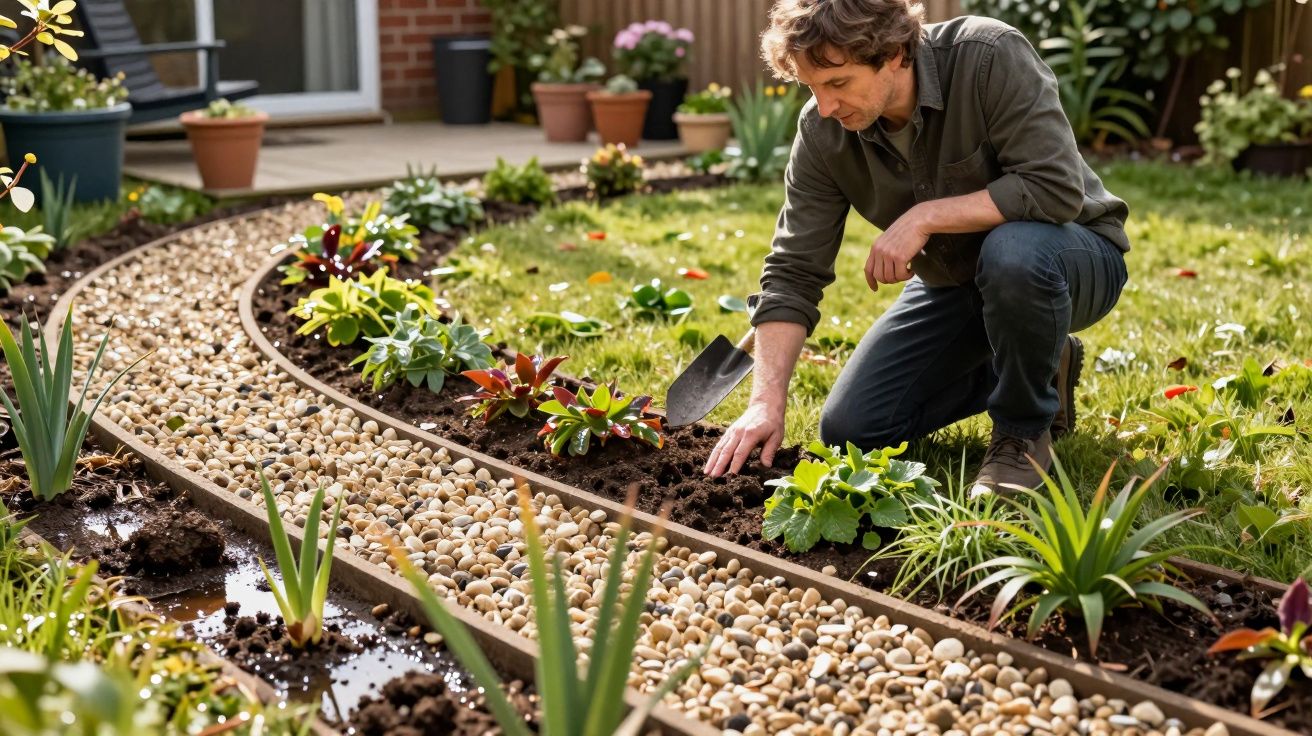
The tidy garden plan is seductive: a ruler-straight path, matching beds, shrubs clipped into obedience. But eco-friendly garden design and naturalistic planting schemes don’t thrive on that kind of certainty, especially in the UK where a single week can deliver drought, downpour and a surprise late frost. If you want a garden that stays greener with less work, the trick is usually to stop forcing everything into straight lines and start using the shapes that already fit your site.
I watched a neighbour re-edge his border for the third time in one summer. The soil kept slumping onto the path, the lawn kept browning at the corner where the sun bakes it, and every heavy rain carved a tiny channel right along his perfectly “clean” edge. The garden wasn’t being difficult. It was giving feedback.
There’s a quieter way to build a garden that listens back.
Why straight lines fight water, wind and time
Straight edges are great for measuring, but they’re not great at negotiating. Water accelerates along the easiest route; wind funnels down corridors; sun hits exposed corners harder than it hits a gently curving bed. When you draw long, clean lines across a slope or compacted ground, you often create the exact conditions that dry out plants and wash away soil.
Naturalistic planting schemes work because they assume irregularity is normal. A border that bulges where it’s wet, narrows where it’s dry, and softens its edges with groundcover is not “messy”; it’s tuned. The microclimates do the organising, and your job becomes guiding them rather than correcting them.
A simple test: stand outside during a proper rain and watch where the water wants to go. It rarely travels in a neat rectangle.
The greener garden move: design with flows, not borders
Think of your garden as a set of flows-water, light, foot traffic, and wildlife routes-then place plants and paths where they reduce friction.
- Water flow: Use shallow basins and gentle swales to slow runoff and let it soak in. Curves buy time; time grows plants.
- Light flow: Let sunnier areas host tougher, drought-tolerant plants; let partial shade carry the leafy, moisture-loving ones.
- Human flow: Put a path where you already walk, not where the drawing says you should. Desire lines are honest.
- Wildlife flow: Join habitats together: a hedge to a shrub bed to a small pond zone beats isolated “wild corners”.
In eco-friendly garden design, the goal isn’t to make nature look wild. It’s to make the garden behave like it has a plan, even when the weather doesn’t.
How to soften a garden without making it look scruffy
The fear is always the same: “If I stop edging, it’ll look like I’ve given up.” The fix is structure-just not the rigid, geometric kind.
Use repeating shapes, not perfect symmetry
Repeat a curve rather than mirror a bed. Echo the same drift of plants in two places. Repetition reads as intentional even when the outline is informal.
A reliable pattern is big shapes, small details: one sweeping bed line, then a few crisp elements (a gravel strip, a single clipped evergreen, a bench) to anchor the eye.
Plant in drifts that match the site
Naturalistic planting schemes look best when plants are grouped like they’d choose to be: not one of everything, but clusters that swell and thin.
- On dry, sunny edges: thyme, sedum, salvias, yarrow, stipa grasses
- In average, “doesn’t know what it is” soil: hardy geraniums, nepeta, astrantia, alchemilla
- In damp dips: iris, ligularia, filipendula, hosta (with slug strategy), moisture-tolerant grasses
You’re not decorating a border. You’re building a community that can handle a bad week.
Let edges blur-then keep one line crisp
A greener garden often needs a “forgiveness zone”: creeping groundcover that knits soil together, catches leaves, and shades out weeds. But choose one place to keep sharp, so the whole garden reads tidy.
Good options: - A mown strip of lawn alongside a bed (easy, cheap, looks deliberate) - A gravel margin (excellent for drainage and path clarity) - Steel edging only where erosion is a real issue, not everywhere out of habit
“Messy everywhere is messy. Soft planting with one clear frame is calm.” - a rule borrowed from parks teams who maintain large areas with limited time.
The low-maintenance win: fewer inputs, fewer rescues
Straight-line gardens tend to demand constant correction: edging, re-levelling, replanting corners that cook, re-turfing strips that never establish. Curved beds and layered planting reduce the need for all that because they do three boring, brilliant things:
- Shade soil so it stays damp longer and microbes keep working.
- Slow wind with varied heights instead of a flat, exposed surface.
- Hold ground with roots at multiple depths, so rain doesn’t strip the top layer.
If you’re trying to cut watering, stop treating bare soil as normal. Plants are the mulch. Groundcover is the sealing wax.
A practical layout that works in most UK gardens
You don’t need a full redesign. You need a small shift in geometry.
- One main curve: redraw one straight bed edge into a gentle S-curve that responds to sun and shade.
- Three layers of planting: tall (structure), medium (seasonal colour), low (groundcover).
- A water-catcher: a shallow dip at the lowest point filled with moisture-tolerant plants or gravel and iris.
- A repeat plant: pick one species and repeat it in drifts so the garden has rhythm.
Here’s a compact “starter map” you can copy:
| Garden need | Curved/soft solution | Why it helps |
|---|---|---|
| Dry border corners | Pull the bed line in; plant drought-tolerant drift | Less exposed soil, less scorch |
| Runoff from patio | Shallow swale + moisture lovers | Soaks water in, reduces puddles |
| Weedy open soil | Groundcover matrix planting | Shades weeds, stabilises soil |
What to do if you love straight lines anyway
Keep them where they earn their keep: by the house, around a seating area, along a vegetable bed you actually measure. Straight lines are useful when you’re moving furniture, pushing a wheelbarrow, or laying out crops.
Then let the rest of the garden be more negotiable. A formal terrace can fade into softer beds. A crisp path can widen into a planted edge. The point isn’t banning geometry; it’s not making the whole garden live by it.
FAQ:
- Isn’t a naturalistic garden just “letting it grow”? No. Naturalistic planting schemes are planned: repeated plants, layered heights, and a clear edge somewhere so the whole space reads intentional.
- Will curves make my garden look smaller? Usually the opposite. Curves hide the full view, create depth, and stop the eye hitting a hard boundary all at once.
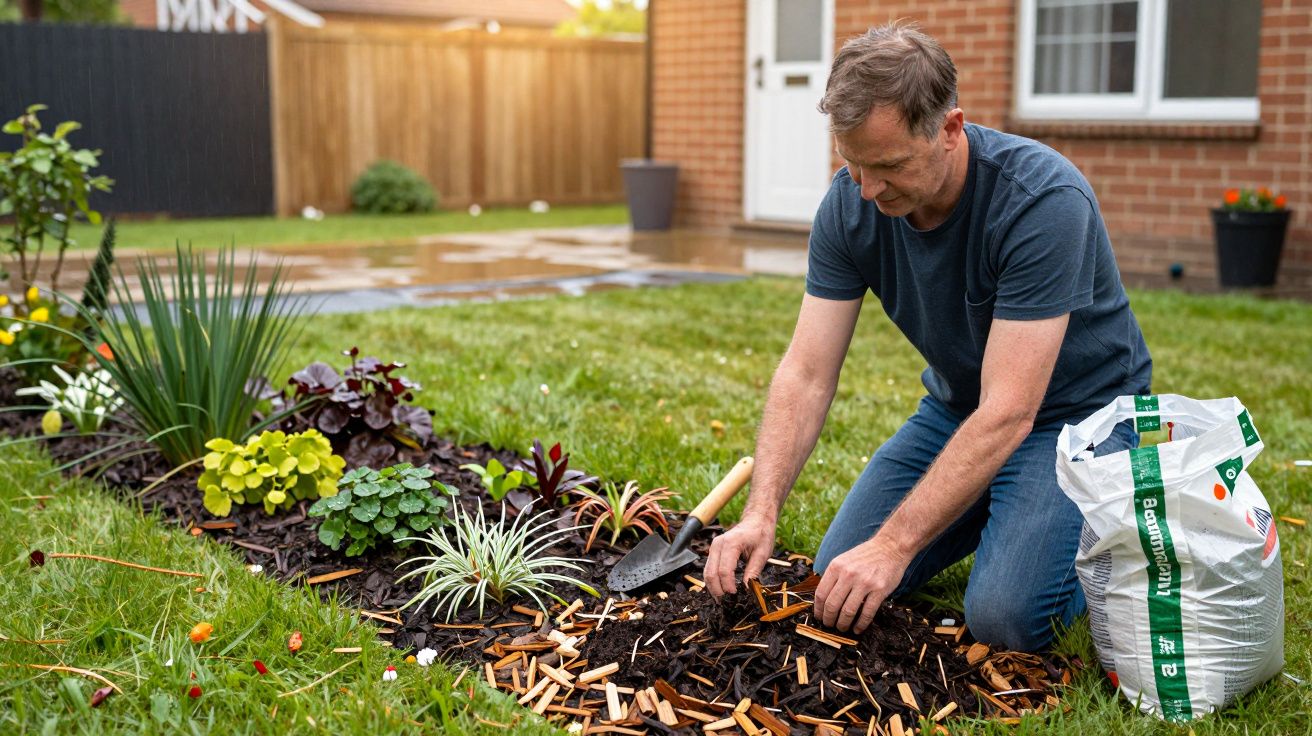
- What’s the quickest eco-friendly change I can make this weekend? Stop leaving soil bare. Add a groundcover drift (or mulch if you’re between plantings) to reduce watering and weeds immediately.
- Do I need a pond for wildlife? Not essential, but even a shallow water bowl and dense planting can help. If you can add a small damp area or bog-style bed, biodiversity tends to rise fast.
- How do I keep it looking tidy in winter? Leave seedheads for birds, but keep one crisp frame: a mown strip, a gravel edge, or a clear path line. Structure does the visual work when flowers aren’t out.


Comments (0)
No comments yet. Be the first to comment!
Leave a Comment