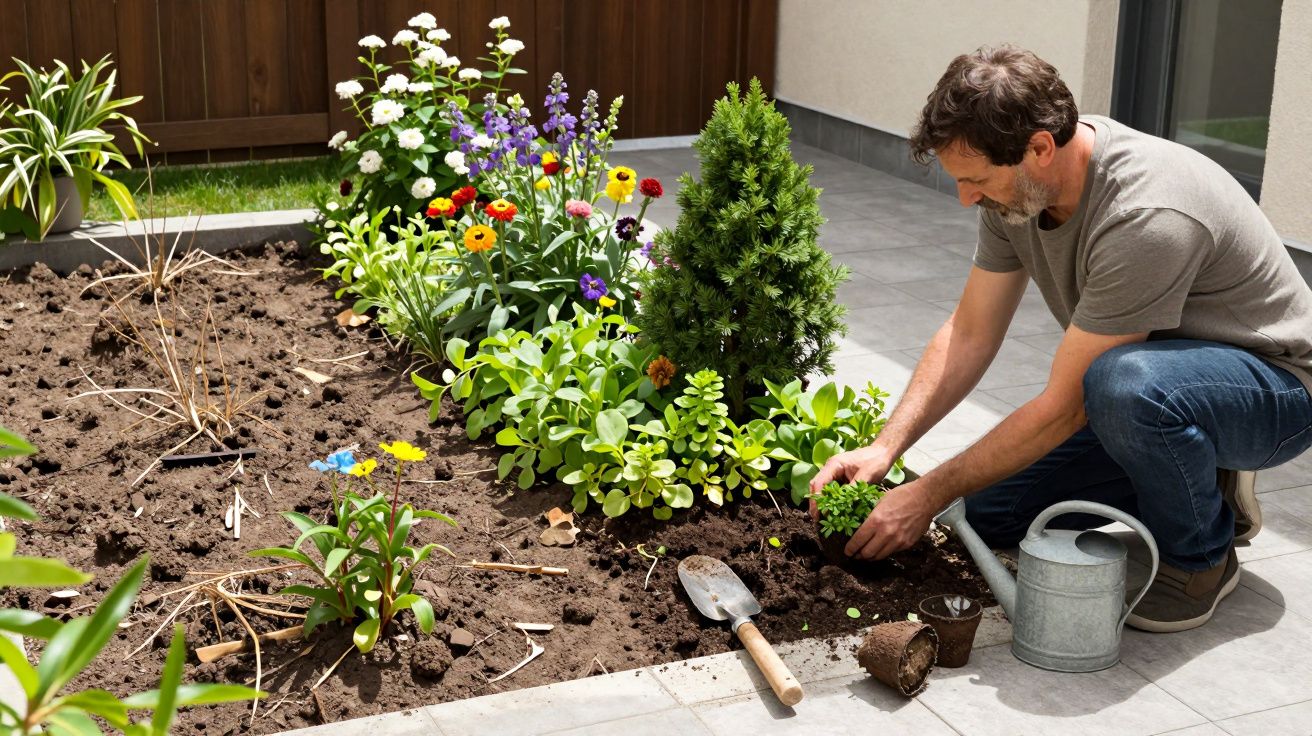
Mixed planting layers are the quiet architecture behind most eco gardens: groundcovers stitching soil, perennials holding the middle, shrubs and small trees giving height and shelter. They sit naturally inside naturalistic planting schemes, where the goal isn’t a neat row of one species, but a community that behaves more like a hedgerow or meadow. For you, that matters because diverse planting is less brittle-fewer bare patches, fewer pest spirals, and a garden that keeps going when weather swings.
I realised this properly the summer my “simple” bed failed. I’d planted one star performer in a confident sweep, loved it for six weeks, then watched it sulk in a hot spell, get hammered by mildew, and leave a thin, exposed soil crust behind. The garden didn’t look wrong because the plant was wrong; it looked wrong because there was nothing else there to catch the slack.
The quiet logic: gardens that can’t lean on one leg
A single plant type asks for a single set of conditions, all season long. But real gardens are messy systems: dry shade at the back of a border, a wet pocket by the downpipe, wind tunnelling between fences, heat radiating off paving. Monocultures don’t adapt; they insist.
Mixed planting layers spread risk the way a good city plan does. When one species finishes early, another comes on. When one gets chewed, another still holds structure. And when the weather throws a curveball-late frost, week-long rain, a sudden drought-the garden has more than one strategy available.
In naturalistic planting schemes, this isn’t just aesthetics. It’s function dressed as beauty: the “random” drift of different leaf shapes, heights, and root depths is actually the system bracing itself.
What mixed layers actually do (when nobody’s watching)
You can’t always see the work, but you can see the results: fewer weeds, steadier moisture, and plants that look oddly relaxed in August.
Here’s what’s happening underneath and between the stems:
- Root depth diversity: shallow roots sip surface water; deeper roots keep going when the top dries. Together, they use rainfall more efficiently.
- Living mulch: low plants shade soil, reducing evaporation and stopping weed seeds getting light.
- Microclimate building: taller stems slow wind and cast dappled shade, which reduces stress on tender plants.
- Pest dilution: a pest looking for “its” plant has to travel further; predators get more habitat and more consistent food.
- Soil biology support: varied root exudates feed a broader range of microbes, improving nutrient cycling over time.
It’s not magic, and it isn’t maintenance-free. It’s simply a garden designed like an ecosystem rather than a display shelf.
How to build a layered planting without overcomplicating it
Start with intent, not a shopping list. Decide what you need the bed to do: suppress weeds, hold a slope, feed pollinators, look good in winter, survive holiday drought.
Then build from the ground up:
- Pick a “matrix” layer (40–60% of the planting): a reliable, mostly low plant that knits space together. Think tough grasses, low sedges, or spreading perennials suited to your soil.
- Add seasonal “characters” (20–40%): flowering perennials and bulbs that take turns through the year-spring lift, summer colour, late-season nectar.
- Add “structure” (10–20%): shrubs, subshrubs, or upright perennials that hold shape in winter and give height and cover.
- Leave deliberate breathing room: plants need space to knit; cramming everything in makes a damp, disease-friendly thicket.
Let’s be honest: most of us plant like we’re filling gaps in a picture. Layering works better when you treat gaps as future canopy.
Common hiccups are predictable. Too many “stars” and no matrix means the bed looks scattered and weedy. Too much matrix and it looks flat. And if every plant wants the same moisture level, the first odd season will expose it.
“You’re not planting a collection. You’re planting relationships,” a nursery grower told me, tapping a pot as if it could hear.
Why eco gardens prefer mixtures over perfect control
Eco gardens are trying to do two things at once: look intentional and reduce inputs. A single plant type often needs the opposite-more feeding, more watering, more spraying, more dividing, more replacing.
A layered mix helps you lean on biology instead of bottles. Pollinators arrive earlier and stay later because there’s always something in flower. Birds and beneficial insects have cover, not just a summer buffet followed by winter emptiness. Even leaf litter becomes useful: it falls into a textured understory instead of sitting on bare soil like a problem you must tidy.
There’s also a psychological payoff that’s easy to underestimate. When you stop insisting on one “perfect” plant doing all the work, you start designing for resilience-and the garden becomes calmer to manage.
| Principle | What you do | What you get |
|---|---|---|
| Layer the canopy | Groundcover + mid-layer + structure | Less bare soil, more stability |
| Stagger bloom times | Early, mid, late-season plants | Longer pollinator season, steadier look |
| Mix functions | Nectar, seed, shelter, soil cover | Fewer inputs, more wildlife |
FAQ:
- What if I love the look of one plant repeated? Keep repetition, but repeat groups within a mix: a consistent matrix plant throughout, plus repeated accents, rather than a single-species block.
- Do mixed planting layers make a garden look messy? They can, if there’s no structure. Add a clear edge, repeat a few key plants, and include upright forms that read as “intentional”.
- How many species is “enough”? For a small bed, 5–9 is often plenty: 1 matrix plant, 3–5 perennials, 1–2 structural plants, and a few bulbs.
- Is this just for big, meadow-style gardens? No. Layering works in a courtyard border or a few large containers-choose compact plants and keep the proportions the same.
- What’s the fastest win if my bed is already planted? Add a ground layer. A tough, compatible groundcover can reduce weeds and stress quickly, and it makes everything above it look more deliberate.





Comments (0)
No comments yet. Be the first to comment!
Leave a Comment