
You can spot climate-resilient gardens in the first minute because they feel slightly “off” if you’re used to tidy borders: they borrow their logic from natural landscape design, not from a ruler. They’re built for heatwaves, downpours, hosepipe bans and weird shoulder seasons, and that only works when the planting can flex. Symmetry looks calm on day one; resilience looks calm on day fifty, when the weather has had a go.
I learned this the hard way after a summer where my perfectly matched pair of beds behaved like two different planets. One baked, one stayed damp, and my mirror-image plan turned into a lopsided argument with the sun. The more I tried to force it back into balance, the more obvious it became: my garden wasn’t failing. My symmetry was.
Why symmetry breaks first when the weather gets strange
Symmetry assumes the two sides live the same life. Same light, same wind, same soil depth, same drainage, same foot traffic, same heat reflected off walls and paving. In a real garden, those conditions almost never match, and climate change turns the tiny differences into loud ones.
A heatwave doesn’t just “dry the garden”. It bakes the bed by the south-facing fence, while the bed by the shed stays cooler and holds moisture. A cloudburst doesn’t “water everything”. It races down the slight slope you didn’t notice, pools in the low corner, and leaves the raised bit thirsty again by lunchtime.
When you plant mirror images, you’re also mirroring expectations: the lavender on the left should thrive because the lavender on the right thrives. But plants don’t perform; they respond. If one side is stressed, the whole symmetrical picture looks broken, even if the garden is actually doing fine in survival terms.
The microclimate truth nobody sketches into a formal plan
The trick is to stop thinking in halves and start thinking in patches. Your garden is a handful of microclimates stitched together: hot strip, wet pocket, windy gap, shady edge, compacted path, sunny wall. In a resilient garden, you design for those patches instead of pretending they aren’t there.
Here’s the part that changes everything: you don’t need “even” conditions to have a garden that feels cohesive. You need repeatable relationships-texture, height, seasonal rhythm-so the eye reads it as intentional, even when the plants are making their own weather-driven edits.
A good rule I stole from natural landscape design is to repeat communities, not clones. You can repeat a vibe (grasses + daisies + umbellifers) without repeating the exact same individuals in the exact same positions. That way, if one pocket fails in a drought year, the whole composition doesn’t collapse into obvious imbalance.
What climate-resilient gardens do instead of mirror images
They trade symmetry for redundancy. Not in a messy way-more like how a well-packed bag has backups in different pockets. You build “layers” so one plant can step in when another sulks.
Think in three layers:
- Structure: shrubs, small trees, tough evergreens, or architectural perennials that hold the shape.
- Matrix: grasses and groundcovers that knit soil, shade roots, and reduce evaporation.
- Seasonal sparkle: short-lived flowers and self-seeders that come and go without ruining the plan.
If a heatwave knocks the sparkle out, the structure and matrix still make the garden look composed. If winter wet rots something in a low spot, the matrix stops the bare-soil spiral and the garden doesn’t unravel.
I also stopped pairing “twins” across a path and started planting in drifts that can slide. A drift can thin on one edge and thicken on another without looking like a mistake; it looks like movement. Symmetry can’t do that without looking wrong.
A practical way to design without symmetry (and still feel “tidy”)
I use a quick method when I’m tempted to centre everything and make it match.
- Map the stress zones in five minutes: where it bakes, where it puddles, where it’s windy, where it’s shaded, where the soil is thin.
- Pick three repeatable plant “families” that can tolerate your extremes (for UK gardens: drought-tough perennials for the hot strip; moisture-tolerant plants for the sump corner; and something windproof for the exposed edge).
- Repeat each family in at least three places, but tweak the species/cultivar to suit the microclimate.
This is the bit that keeps it from looking like a jumble: repetition. Not symmetry-repetition. The same grass popping up again, the same leaf shape echoed, the same soft haze of seed heads in multiple pockets.
If you like a sense of formality, you can keep one strong line-an edge, a path, a clipped hedge-and let the planting be freer. A straight path with an “untidy” border often reads calmer than two perfectly matched beds that are constantly failing in different ways.
The hidden bonus: asymmetry makes maintenance lighter
Symmetry is high maintenance because it demands synchronised growth. Two sides must be pruned the same week, fed the same way, replaced at the same time, watered evenly. In a shifting climate, that’s a full-time job disguised as “neatness”.
Climate-resilient gardens accept that one corner will be earlier, another later. The maintenance becomes responsive rather than corrective. You’re not constantly trying to restore a picture; you’re supporting a system.
A few swaps that helped me:
- Replace thirsty “border fillers” with plants that shade their own roots (groundcovers, tough geraniums, low grasses).
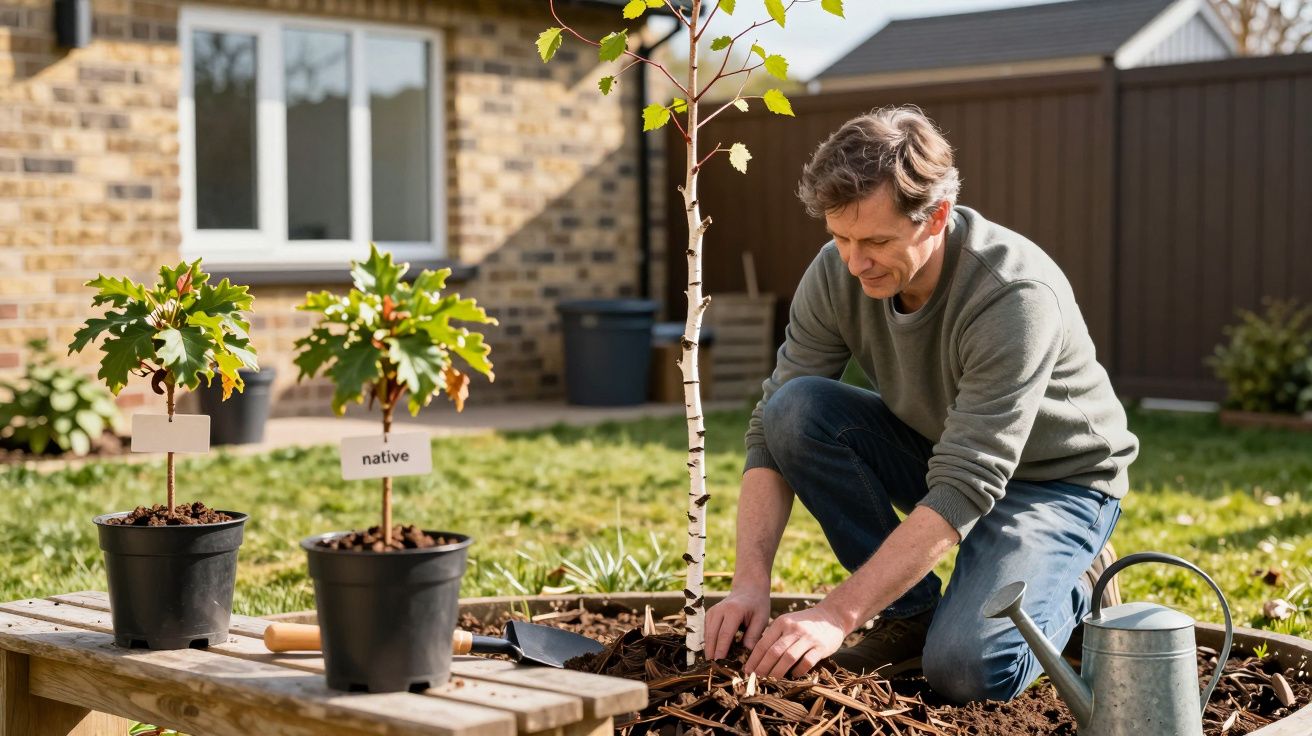
- Use mulch as design, not apology: a thick organic layer that keeps moisture and evens soil temperature.
- Choose plants with multiple wins: long season, good structure when not flowering, and wildlife value when stressed.
It’s oddly relaxing when the garden is allowed to be a little uneven. The goal shifts from “match” to “cope”, and suddenly the whole place looks better for longer.
| Shift | What you do | Why it works |
|---|---|---|
| Mirror → Patch | Plant for microclimates, not halves | Weather extremes hit unevenly; your planting can absorb that |
| Clone → Community | Repeat groups, not identical plants | Failure in one spot doesn’t ruin the whole composition |
| Picture → System | Prioritise structure + matrix | The garden stays coherent through drought, deluge, and gaps |
FAQ:
- Do I have to give up a formal look to be climate-resilient? No. Keep strong lines in hard landscaping or evergreen structure, and let the planting be more flexible and patch-led.
- Won’t asymmetry just look messy? It can, if there’s no repetition. Repeat a few key shapes and textures across the garden so it reads as intentional rather than random.
- What’s the quickest “resilience” change I can make this season? Mulch well and increase groundcover/matrix planting. It reduces evaporation, buffers soil temperature, and makes watering more effective.
- How do I decide what goes in the wet corner versus the hot strip? Watch after rain and on a hot afternoon. Plant for what’s already happening, not what you wish was happening.
- Is symmetry ever useful? Yes, in small doses: a pair of pots by a door, matching shrubs framing a view, or a repeated rhythm along a path. Just don’t make the whole garden depend on identical conditions.





Comments (0)
No comments yet. Be the first to comment!
Leave a Comment