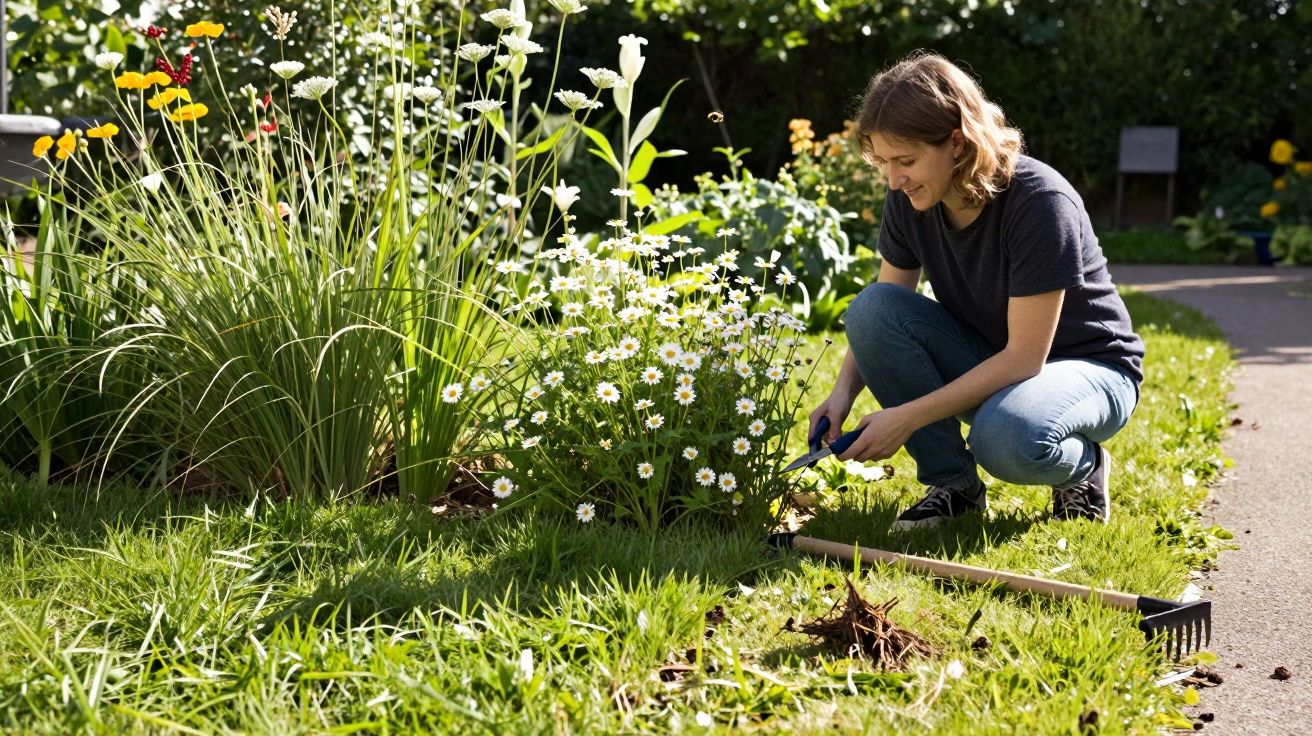
People talk about wildflower meadows as if the magic is just “more flowers”, but the real shift happens when you treat them like pollinator habitats with edges, routes, and safe places to land. You can sow the prettiest mix in the world and still watch it stall-thin patches, fewer bees by midsummer, colour that peaks once then fades. One small detail decides whether a meadow behaves like a poster or like a living system.
I noticed it on a footpath behind a primary school, where the council had done everything “right”: fresh seed, a tidy sign, a neat rectangle mown like a picture frame. It looked generous from a distance. Up close, it was oddly quiet.
Then, ten metres along, a scruffier strip broke the rule. The edge wasn’t a sharp mow-line. It was a soft, messy seam.
The detail most meadows miss: a “soft edge” that stays
A wildflower meadow doesn’t begin in the middle; it begins at its boundary. That boundary is where wind dries the soil first, where grasses invade, where dog paws compact the ground, where you end up mowing “just a bit wider” each year without noticing. It’s also where pollinators decide whether the place feels safe enough to work.
A hard edge-meadow to short turf in one step-looks clean but functions like a cliff. A soft edge-meadow to taller tussocks to short turf over a metre or two-acts like a ramp. It gives shelter, warmer microclimates, and staggered flowering that covers the awkward weeks when the main flush is over.
You can feel it with your ankles. One side is breezy and exposed, the other holds warmth and smells faintly of dry stems and resin. In that seam, you see hoverflies pausing, bumblebees choosing lanes, butterflies settling as if they’ve found a doorway.
Why pollinators behave differently at a soft edge
The science-y version is “structural complexity”. The human version is simpler: small creatures avoid being in the open when they don’t have to.
A soft edge gives three things at once:
- Wind breaks and sun traps. Tussocks and half-height plants make calmer air pockets where insects can feed without being knocked off a flower.
- A longer season. The edge warms earlier in spring and stays usable later in autumn, so you get activity before and after the meadow’s main peak.
- Navigation. Bees and flies use linear features like hedges, long grass, and rough margins as corridors. A hard edge breaks that route; a soft edge continues it.
If your meadow sits in a park, a verge, a new-build green, or a back garden surrounded by lawn, this is the difference between “we planted wildflowers” and “we built a habitat”.
Make the soft edge in one afternoon (without losing the tidy look)
You don’t need to let the whole thing go feral. The trick is to choose where you’re messy and where you’re crisp.
Pick one or two sides of your meadow-ideally the sunnier side and the side facing the prevailing wind-and create a transition strip. Aim for 1–2 metres wide if you can; even 50–80 cm helps in a small garden.
Here’s a simple, repeatable method:
- Mow or strim a narrow path first. This is your “it’s intentional” line. It keeps the space readable for people.
- Leave the next strip half-high. Cut it once, early, to about 15–20 cm, then let it regrow. This becomes your shelter band.
- Let the meadow start after that. Full height, full flower, no constant “tidying” at the boundary.
- Add one anchor plant type. A clump-former at the edge-knapweed, scabious, oxeye daisy, yarrow-gives a reliable landing zone even when annuals dip.
Common mistake: mowing the meadow edge whenever you mow the lawn “just to keep it neat”. That turns the shelter band into a repeated disturbance zone and invites coarse grass to win. If you want neatness, keep it in the path, not in the habitat.
The maintenance rhythm that stops a meadow from collapsing
Most meadows don’t fail because the seed was wrong. They fail because the boundary and the cut schedule pull in opposite directions.
A practical rhythm that works for many UK sites:
- Spring: leave it alone except for paths; spot-cut only where nettles or thistles are genuinely dominating.
- After main flowering (late summer): cut the meadow and remove arisings (the cut material). This is non-negotiable if you want wildflowers to compete with grass.
- Autumn: keep the soft edge mostly standing. That standing structure is overwintering space-stems, seed heads, hiding places.
- Winter/early spring: one light tidy of the shelter band if it’s flopping into paths, but don’t scalp it.
Let’s be honest: nobody does the “remove all arisings” part perfectly every year. But even partial removal-raking, lifting, or collecting a few runs-pushes the meadow back towards flowers rather than grass.
The wider picture hiding in a narrow strip
Once you notice edges, you start seeing why some wildflower meadows feel alive and others feel decorative. It’s not only about species lists. It’s about the seams between habitats: meadow to hedge, meadow to path, meadow to ditch, meadow to scrub.
And that’s good news, because seams are cheap. You can’t always change soil, rainfall, or what your neighbours spray on their lawn. But you can change how your meadow meets the world.
| Point clé | Détail | Intérêt pour vous |
|---|---|---|
| Soft edge (transition strip) | A 0.5–2 m band from short grass to taller cover | More shelter, more pollinator activity, less edge die-back |
| “Intentional” neatness | A mown path as the crisp line | Keeps it looking cared-for without harming the habitat |
| Cut + remove arisings | Late-summer cut with material taken away | Keeps fertility down so wildflowers can compete |
FAQ:
- Should I add a soft edge on every side of my meadow? Not necessarily. Start with one or two sides-especially sunny or windy edges-and keep the rest defined with a path.
- Will longer grass at the edge make it look messy? It can, unless you pair it with one crisp element (a mown strip, a clear curve, or a short path) that signals intention.
- Do soft edges increase weeds like brambles and nettles? They can if the soil is rich and unmanaged. The fix is targeted spot-cutting and, crucially, removing arisings after the main cut.
- What if my meadow is tiny, like a 2 x 2 metre patch? A soft edge can still work-make it 30–50 cm and keep a narrow mown border or stepping-stone path to stop trampling.
- Is this better than buying a more expensive seed mix? Often, yes. A good mix helps, but edge structure and cut/removal habits usually decide whether the meadow persists beyond the first impressive year.





Comments (0)
No comments yet. Be the first to comment!
Leave a Comment