
You notice it in late winter, when the garden is at its most unforgiving and everything looks like a mistake. Sustainable landscaping and long-term ecological planning are meant to make outdoor spaces resilient, cheaper to run, and kinder to wildlife, but there’s an awkward stage where it just looks… messy. Like you’ve given up, or worse, like you’ve done something “clever” from the internet and now you’re committed.
The idea is simple, which is partly why it’s so hard to trust: stop trying to keep every inch tidy, and start building a garden that behaves more like a small ecosystem. It begins with letting organic matter lie where it falls and planting in drifts rather than little perfect specimens. For a while, it can look chaotic. Then the results arrive, quietly and all at once.
The moment your garden starts looking “wrong”
Most people hit it after a weekend of good intentions. You’ve pulled weeds, cut things back, maybe even done that earnest thing where you edge the lawn until it looks like it’s been trimmed with nail scissors. The next week, the wind drops twigs everywhere, the border looks bare again, and the soil is either baked or soggy depending on the mood of British weather.
The default reaction is to fight it: rake, sweep, bag, bin. You remove last season’s leaves because they look untidy. You scrape the soil clean because it seems “neat”. You keep the ground exposed as if it’s meant to be seen, rather than protected.
But bare soil is a kind of invitation. It invites evaporation in a heatwave, compaction in heavy rain, and a constant parade of opportunistic weeds. It also invites you to keep spending your weekends doing pointless maintenance that never seems to end.
The sustainable idea that looks chaotic: “soft mulching” with a living edge
The trick is to treat the ground like it hates being naked (because it does). Instead of manicured, open soil and sharply separated beds, you create a soft, layered surface that feeds itself: a mix of leaf litter, chopped plant stems, compost, and wood chip-plus a low, spreading “living edge” of plants that knit it all together.
It looks chaotic at first because it isn’t uniform. It’s not a crisp bark mulch laid like a carpet. It’s more like what you’d find at the edge of a woodland path: textured, uneven, alive. The point isn’t prettiness. The point is function.
If you do it properly, you get three wins that don’t sound dramatic until you’ve lived with them:
- Soil that stays damp for longer, even when watering rules kick in.
- Fewer weeds, because you’ve blocked the light and disrupted the open ground they love.
- A bed that improves each year instead of exhausting itself.
Why it works (and why it takes time to look good)
Mulch isn’t just decoration. It’s a buffer. It steadies the extremes that make gardens hard work: heat, drought, pounding rain, and that miserable spring wind that dries everything out while you’re standing there with a watering can.
A layered surface also feeds the soil food web-worms, fungi, bacteria-without you needing to “do” much. Those organisms break down material into structure and fertility. Over time, the soil becomes darker, crumbly, and easier to plant into. That’s when the garden starts to look intentional again, because the plants suddenly look as if they’re thriving “without effort”.
The chaos phase is basically the garden digesting.
How to do it without turning your plot into a compost heap
There’s a difference between soft mulching and dumping. The aim is to be loose, not careless; layered, not smothered. A simple routine helps.
1) Keep your “brown” and “green” materials separate in your head
You don’t need a perfect carbon-to-nitrogen ratio, but it helps to know what you’re throwing down.
- Brown (slow, structuring): fallen leaves, shredded cardboard (plain, no glossy print), wood chip, straw, twiggy prunings (chopped).
- Green (quick, feeding): grass clippings (thin layers), soft green prunings, spent annuals (disease-free), kitchen veg scraps (best composted first).
If you put thick, wet green layers straight on soil, you risk a slimy mat and the sort of smell that makes you doubt every life choice. Mix greens thinly, then cap with a brown layer.
2) Start in one bed so you can trust it
Doing the whole garden at once is how you end up overwhelmed and resentful. Pick the bed you hate watering. Or the one that’s always weedy. Or the one you can see from the kitchen sink.
Then do this:
- Weed once, properly, removing big roots.
- Water the soil if it’s dry (mulch holds moisture; it doesn’t conjure it).
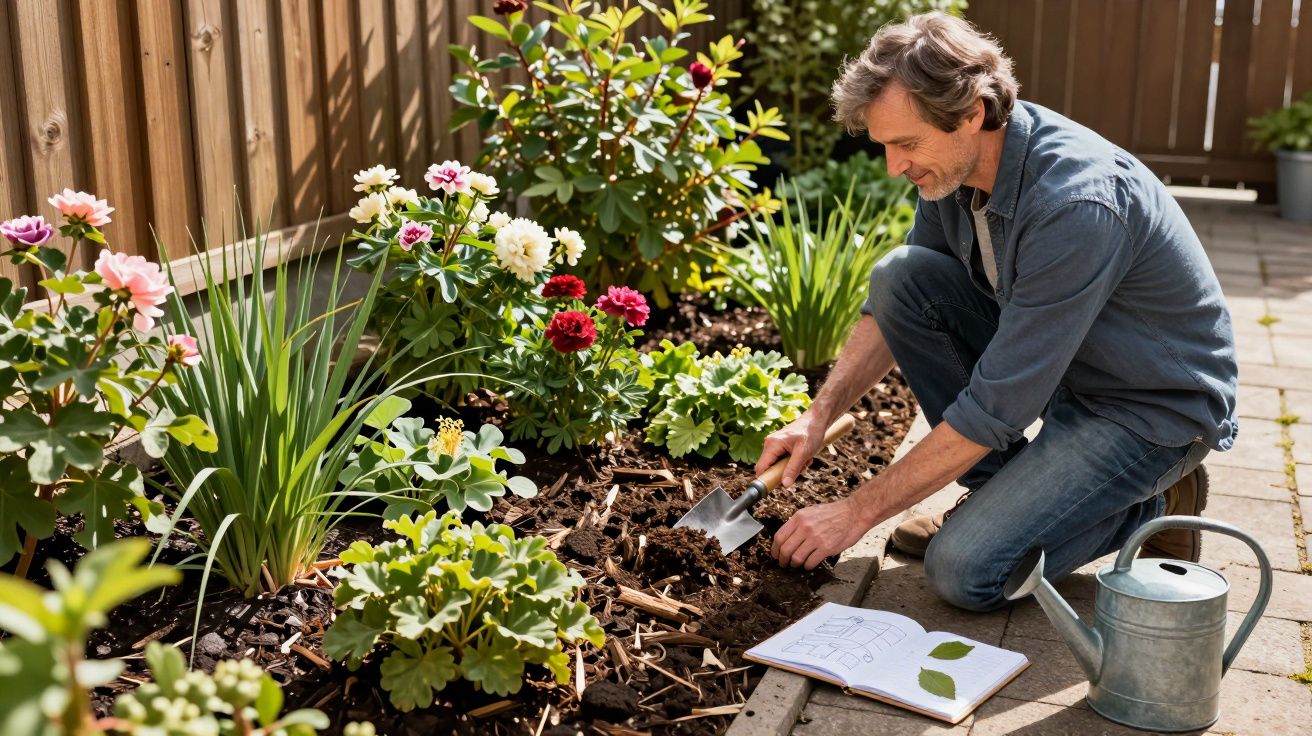
- Lay 5–8cm of mixed mulch, keeping it clear of plant crowns and stems.
- Add a “living edge” around the front: low, spreading plants that tolerate being ignored.
3) Choose a living edge that behaves itself
This is what makes the whole thing look like a garden again. The edge is your visual reassurance. It tells your brain, “Yes, this is deliberate.”
Good options for UK gardens:
- Creeping thyme (sun, light foot traffic, pollinators love it)
- Ajuga reptans (shade tolerant, purple flowers, can spread-use where you mean it)
- Strawberries (ground cover you can eat, decent at filling gaps)
- Geranium macrorrhizum (tough, aromatic leaves, brilliant in dry shade)
- Sedum (sun, drought tolerant, neat shapes)
Avoid anything you already know will run riot in your conditions. If mint has ever escaped a pot in your garden, you don’t need more proof.
The bit nobody mentions: it will look worse before it looks better
For a few weeks, the bed can look like a half-finished project. The mulch settles unevenly. Blackbirds flick it about looking for snacks. The odd stem sits at an angle that makes you want to tidy it.
This is the stage where most people panic and “fix” it back into neatness. They rake the layers flat, exposing soil again. They remove leaf litter because it looks scruffy. They defeat the entire point out of pure aesthetics.
If you can tolerate the awkward middle, you get a spring where weeds germinate and simply… fail. You get summer watering that becomes occasional rather than constant. You get soil that doesn’t turn to dust or sludge at the first sign of weather.
And you start noticing wildlife, because you’ve finally given it something to live in.
What results to expect (and when)
Sustainable garden changes are rarely instant. They’re cumulative, like paying into an account you can’t see for a while. But there are predictable milestones.
- After 2–4 weeks: less surface drying; the bed looks “settled”; fewer new weed seedlings.
- After 1 season: plants establish faster; watering needs drop; soil is easier to dig.
- After 1–2 years: you see real soil structure-worms, crumb, darker colour-and the garden starts looking abundant rather than sparse.
Long-term ecological planning is mostly this: doing small, boring actions that compound until the garden becomes stable enough to carry you through odd weather without constant intervention.
A few quiet rules that stop it going wrong
Some cautions make the difference between “natural” and “problem”.
- Don’t pile mulch against trunks or woody stems; it can trap moisture and encourage rot.
- Avoid mulching with diseased material (especially if you’ve had fungal issues).
- If using wood chip, keep it as a top layer; let it break down slowly while the soil beneath does the real work.
- Add new material little and often, rather than one huge dump that smothers everything.
If you want it to look less chaotic straight away, keep the mulch line crisp at the path edge, and repeat one plant in drifts. Repetition reads as design, even when the surface is deliberately untidy.
The oddly satisfying part: when the garden starts doing the job for you
There’s a moment, usually mid-season, when you realise you haven’t weeded in weeks. Not because you’ve “kept on top of it”, but because there’s less to do. The soil stays cool under your hand. Plants stop looking stressed. The borders begin to knit together and the messy layer becomes background, like a forest floor.
It doesn’t look chaotic anymore. It looks calm. And you start to understand that the tidiness you were chasing wasn’t beauty-it was control.
Soft mulching with a living edge is one of those sustainable garden ideas that asks for trust up front. But if you give it a season, it pays you back in the only currency a garden really respects: less work, more life, and a space that can cope when the weather decides to be itself.



Comments (0)
No comments yet. Be the first to comment!
Leave a Comment