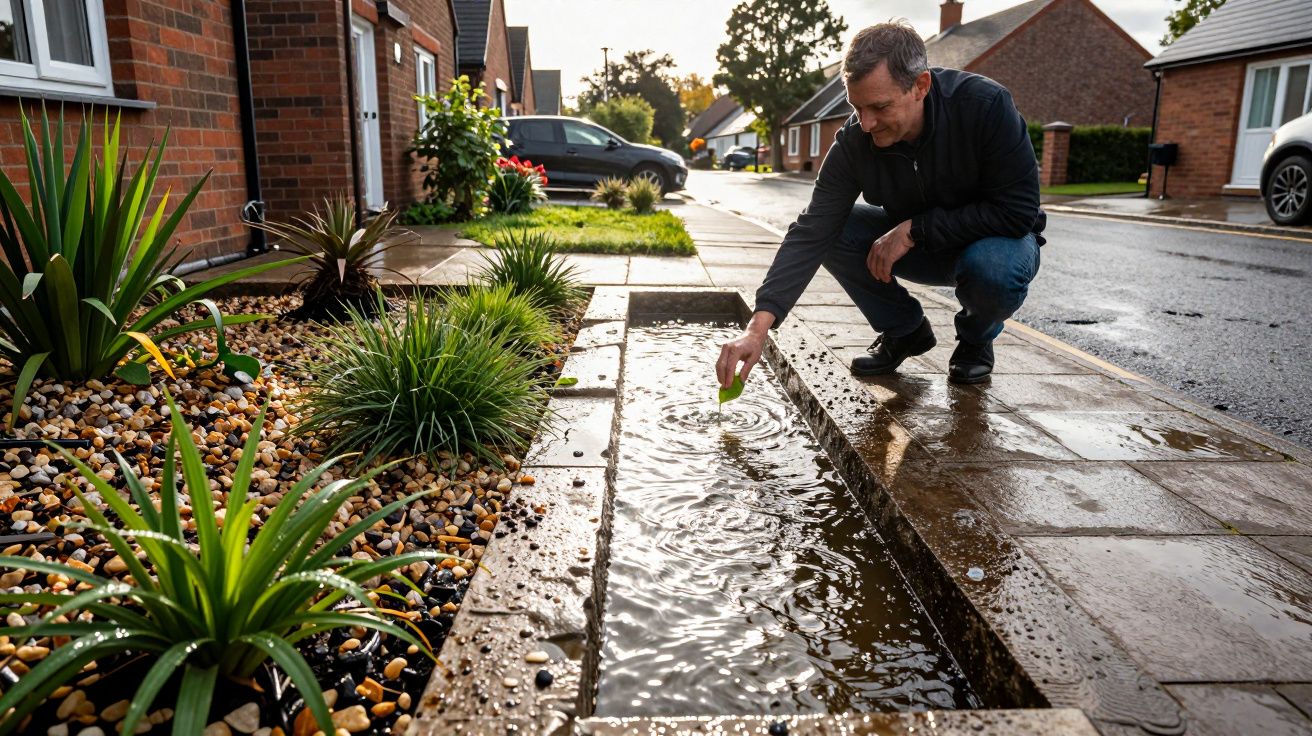
The street always tells on itself after heavy rain: a slick sheen on the tarmac, a fast rush to the nearest gully, and that faint, sour smell where water has sat too long. Rain gardens are built for exactly this moment-shallow planted basins that catch and soak up runoff from roofs, driveways, and pavements-and they fit naturally into water-sensitive design because they treat stormwater like a resource, not a nuisance. If you’ve ever watched a downpour overwhelm drains, this is a small, local feature that makes the whole system feel calmer.
But the part most people miss isn’t the water. It’s what happens around the edges, once you add one simple detail that turns a “drainage fix” into a better place to be.
The feature that changes everything: a planted overflow
Every rain garden needs an exit for the days when the sky ignores your calculations. That’s the overflow-usually a slightly lower point, a pipe, or a shallow swale that carries extra water away once the basin is full. Make that overflow a planted, stone-edged channel (not a bare grate), and you get something that does more than move water on.
It slows the surge, spreads it out, and stops the garden from scouring itself in one violent sheet. It also becomes a visible signal: this is where the water goes, which matters when you’re trying to trust a landscape feature during a storm.
Think of it like giving the rain garden a second job. The basin handles infiltration; the planted overflow handles resilience, clarity, and day-to-day usefulness.
Why “overflow design” is really about comfort and confidence
A lot of rain gardens fail socially before they fail hydraulically. People worry they’ll look swampy, breed mosquitoes, or flood near the house. A clear, intentional overflow answers those fears with geometry rather than reassurance.
A stone-lined lip or a shallow rill planted with tough, wet-tolerant species shows where peak water will travel, so puddles don’t surprise you in the wrong place. The result is less anxiety during downpours and fewer “let’s fill it in” conversations six months later.
There’s also a quieter benefit: the overflow makes the rain garden readable in dry weather. It looks like a designed element, not a dip that got left behind.
The ecology bonus: it becomes a small corridor, not a single island
A rain garden basin can be a lush patch that’s oddly isolated-great plants, then lawn or paving, then nothing. A planted overflow extends habitat like a little green seam through the site, and that’s where you start noticing more than bees on a sunny afternoon.
You get a gradient: damp-tolerant plants in the basin, hardy “splash zone” plants along the overflow, then drier species beyond. That variety supports more insects and birds than one uniform planting, and it stays interesting through the year even when the basin is dry.
If you’ve ever wanted a garden that feels alive without being fussy, this is one of the most efficient ways to get there.
Build it like it has to work in the worst five minutes of the year
Overflows are not decorative. They’re there for the moment your rain garden is at capacity and water is arriving faster than it can soak in. Design for that peak, and everything else becomes easier.
A practical approach looks like this:
- Set the overflow level slightly below any nearby thresholds (air bricks, doors, garages) so the “full” point is controlled.
- Armour the inlet and the lip with stone, cobbles, or a short strip of coarse gravel to prevent erosion where water accelerates.
- Keep the channel shallow and wide rather than narrow and fast; speed is what digs holes.
- Plant for battering: choose species that tolerate occasional flattening and silty deposits, not just pretty foliage.
“Stormwater features don’t need to be big. They need to be obvious about where the water goes.”
Planting that suits a rain garden overflow (without constant babysitting)
The basin planting can be more diverse. The overflow planting should be tougher, simpler, and repetitive enough to read as a line. In UK conditions, favour plants that handle wet feet and dry spells, because an overflow swings between extremes.
Good characteristics to prioritise:
- fibrous roots that hold soil together
- stems that don’t collapse permanently after a surge
- tolerance of silt (because runoff always brings some)
- long season of structure, not just a brief flower moment
If you want one rule that saves time: use fewer species, in bigger clumps, along the overflow. It looks intentional and it’s easier to maintain.
A small checklist before you commit spade to soil
Most problems show up in the siting, not the planting. Walk the area in a real rain if you can, or at least run a hose and watch where water wants to go.
- Where does runoff enter now-downpipe, driveway slope, a low corner of paving?
- Where is the safe “out” during overflow-towards the street, a swale, a soakaway?
- Are you accidentally sending water towards foundations?
- Can you see the overflow line from the house (so you trust it), but not trip over it?
Do those checks and the rain garden stops feeling like a gamble. It becomes a piece of water-sensitive design you can live with-quietly doing its work, and making the whole garden feel more considered.
FAQ:
- Will a planted overflow make my rain garden look messy? Not if you keep the line clear: a defined stone edge or a deliberate shallow channel, planted in repeating clumps, reads as design rather than accident.
- Does an overflow mean the rain garden “fails” in heavy rain? No. Overflow is the safety valve-evidence the garden is working as intended under peak conditions, rather than flooding unpredictably.
- Do I need special maintenance on the overflow? Mostly light tasks: remove litter after storms, top up displaced gravel if needed, and cut back plants annually so the flow path stays open.
- Can I connect the overflow to a drain? Yes, where appropriate and permitted. The aim is controlled discharge: slow, filtered water leaving by a known route, not uncontrolled ponding near buildings.




Comments (0)
No comments yet. Be the first to comment!
Leave a Comment