
The first time I tried mixed planting layers, it looked like I’d lost interest halfway through tidying the border. Tall bits leaning, low bits spilling, the odd “why is that there?” volunteer popping up like it owned the place. But the point of landscaping guided by biodiversity isn’t a crisp finish-it’s a living system that steadies itself over time, with less watering, fewer pests, and more life showing up uninvited (in the good way).
I’d spent years chasing the neat look: bare mulch, a few statement plants, and long gaps that felt calm until summer arrived and the soil baked. Then the aphids came, then the mildew, then the weekly spiral of fixes. I didn’t need more products. I needed more layers.
The moment the garden stopped needing constant attention
It wasn’t instant, and it wasn’t pretty at first. The change started when the ground stopped being visible everywhere, and the wind stopped skimming straight over exposed soil. The border held onto moisture for longer, and the plants looked less stressed after hot spells.
Then the “extras” arrived. Hoverflies. Tiny parasitic wasps. Spiders I pretended not to see until I realised they were doing unpaid work. The garden felt less like a display and more like a neighbourhood, and the balance shifted quietly in the background.
Mixed planting layers work because they copy how plants organise themselves in healthier, wilder places: different heights, different root depths, different flowering times. You’re not making a mess for the sake of it. You’re building resilience.
What “messy” actually means (and why it’s smarter than it looks)
Messy doesn’t mean random. It means you stop insisting that every plant behaves like a lone star on a stage. Instead, you stack roles and let the border act like a small ecosystem.
Think in layers:
- Canopy / tall layer: shrubs, small trees, tall perennials that provide shelter and light shade.
- Mid layer: flowering perennials and grasses that fill volume and feed pollinators.
- Ground layer: low spreaders that cover soil, reduce evaporation, and block weeds.
- Root layer (often ignored): bulbs, deep-rooted plants, and nitrogen-fixers that improve soil structure.
The trick is overlap. When one plant finishes, another takes over. When one struggles, another holds the line. Bare patches are where problems begin: weeds, drying, and pest “hotspots” with nothing to interrupt them.
How to build mixed planting layers in a normal UK garden
You don’t need to redesign everything. Start with one bed or one side of a border and treat it like a trial you can edit next season. I began with the sunniest strip because it was where stress showed first.
Step 1: Pick your “bones” first
Choose 2–3 structural plants that will still look decent in winter and give the bed shape.
Good options (depending on soil and aspect): - Shrubs like sarcococca (shade, scent), ceanothus (sun, pollinators), hydrangea (moisture). - Grasses like miscanthus or calamagrostis for movement and nesting cover. - Small trees if you’ve got space: amelanchier or rowan are wildlife-friendly.
Step 2: Add the long-flowering, insect-heavy middle
This is where the “biodiversity” part pays rent. Aim for a spread across spring to autumn so food doesn’t vanish for months.
Reliable, UK-friendly choices: - Geranium ‘Rozanne’, salvia, verbena bonariensis - achillea, echinacea, rudbeckia - astrantia and foxgloves for part shade
Plant in loose drifts, not strict blocks. Repeat a few plants rather than buying one of everything, otherwise it looks chaotic in the wrong way.
Step 3: Close the soil with ground layer plants
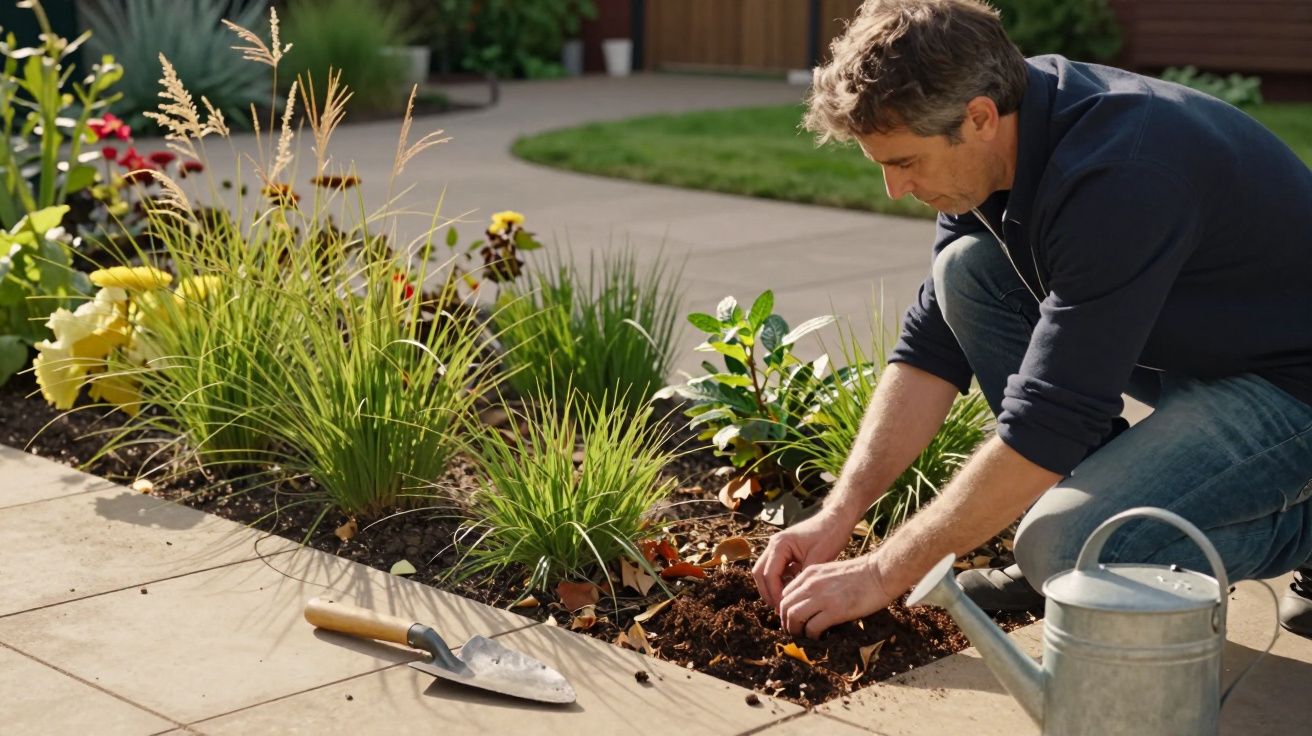
This is where the border starts behaving better. Less splashing in rain. Less baking in sun. Fewer weeds getting a foothold.
Try: - Alchemilla mollis, ajuga, lamium (shade) - thymus, stachys byzantina, low sedums (sun) - strawberries as a semi-edible ground cover in brighter spots
Let’s be honest: nobody keeps every edge sharp in July. Ground cover is you admitting that up front and designing for it.
The biodiversity part: you’re not planting for looks alone
The easiest way to think about landscaping guided by biodiversity is to plant for function, then let the beauty follow. Each layer should do at least one job besides “sit there nicely”.
Here are functions that actually change how your garden runs:
- Nectar and pollen spread: early (crocus, pulmonaria), mid (salvia, geranium), late (sedum, ivy).
- Habitat: grasses and seedheads left through winter; dense shrubs for cover.
- Pest buffering: flowers that attract hoverflies and lacewings near plants that often get aphids.
- Soil protection: ground cover and leaf litter to feed fungi and worms.
If you’ve ever watched a single rose get obliterated while everything around it looks fine, you’ve seen what a monoculture does. Diversity isn’t a moral stance. It’s practical insurance.
Common mistakes that make “messy” feel like just… messy
A layered planting can still look intentional. The difference is usually a few small decisions:
- Too many one-offs: ten different plants, one of each, reads like a clearance trolley. Repeat 3–5 key plants instead.
- No height plan: tall plants all at the front will always look like a flop, even if the ecology is great.
- All flowers, no structure: without shrubs, grasses, or evergreen anchors, winter becomes a sad gap.
- Planting too tight, too fast: it’s tempting to cram. Leave room for year-two growth, then infill with annuals if you need colour now.
A border can be both wildlife-friendly and visually calm. You’re allowed to want both.
The small sign it’s working: less drama, more “normal”
The payoff of mixed planting layers isn’t that everything becomes perfect. It’s that the problems stop arriving like emergencies. The soil stays cooler. The slugs don’t own the whole bed. You notice more birds because there’s somewhere to land and forage, not just a bare runway of mulch.
And the garden starts giving you that quiet, steady feeling: things growing, overlapping, finishing, returning. Not a show garden. A balanced one.
| Shift | What you do | What you get back |
|---|---|---|
| From bare soil to cover | Add ground layer plants and let leaf litter sit | Less watering, fewer weeds, healthier soil |
| From “feature plants” to layers | Mix heights and root depths | Better resilience in heat, wind, and rain |
| From quick fixes to habitat | Plant for insects and shelter | Fewer pest blow-ups over time |
FAQ:
- Is this just “letting the garden go”? No. It’s planned density and overlap, so plants support each other and the soil stays protected. It’s softer-edged, not neglected.
- Will it attract more pests? It can attract more insects, full stop. The goal is to attract predators and pollinators too, so outbreaks are less severe and less frequent.
- How do I stop it looking scruffy in winter? Keep a few evergreen anchors, leave some seedheads for structure, and cut back in late winter rather than autumn for a tidier reset.
- Can I do this in pots or a small courtyard? Yes-use the same idea at a smaller scale: one “tall”, one “filler”, one “spiller”, plus herbs/flowers for pollinators.
- What’s the simplest first change? Stop leaving large patches of bare mulch. Add ground cover and a couple of long-flowering perennials, then build upwards next season.




Comments (0)
No comments yet. Be the first to comment!
Leave a Comment