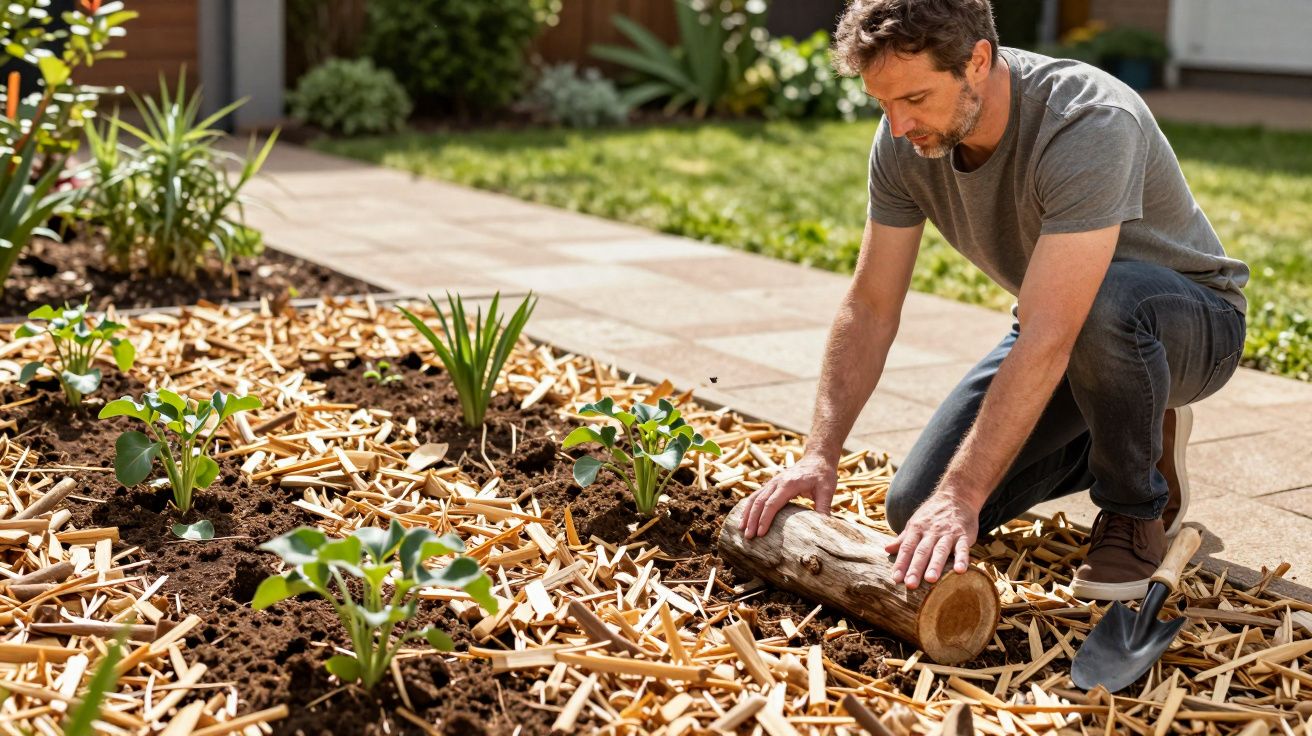
A garden that looks half-done can feel like a mistake. In sustainable landscaping, that “unfinished” look is often a deliberate stage of long-term ecological planning: you’re leaving space for soil, water and plants to sort themselves out before you lock everything into hard edges. It matters because the choices that feel untidy in year one can make maintenance, biodiversity and resilience dramatically easier by year three.
I first clocked this properly in a small back garden that seemed, frankly, neglected. Bare patches between clumps. A few logs stacked like someone had forgotten them. Mulch that wasn’t raked smooth. Then summer arrived and the place behaved differently: fewer scorched plants, more insects, less frantic watering, and a kind of calm that “finished” gardens often lose.
The “unfinished” decision that changes the whole garden
The move is simple: you stop trying to complete the picture immediately. Instead of installing a full scheme in one go-paving, borders, specimen shrubs, neat lawn lines-you build a framework and allow the living parts to expand into it.
That means accepting a few things that look wrong to a human eye trained by show gardens: gaps, rough textures, and edges that soften rather than snap into place. But plants don’t read design magazines. They read moisture, temperature, root space and competition, and they reward you for giving them time.
What it looks like on the ground (and why it works)
An “unfinished on purpose” garden usually has three visible traits:
- More bare soil than you expect, but it’s rarely truly bare: it’s mulched, sown with a cover, or waiting for self-seeders to claim it.
- Messy structure: logs, stones, twig piles, half-rotted stumps, clumps left standing over winter.
- Soft boundaries: paths that are mown, chipped or simply walked in, rather than edged like a patio showroom.
The ecological logic is that complexity builds stability. Mulch buffers soil temperature and reduces evaporation. Decaying wood holds moisture and becomes fungal food. Uneven planting creates microclimates-cool pockets, sheltered corners, sunny banks-so more species can cope with more weather.
A garden that looks “finished” often needs constant correction. A garden that’s allowed to develop needs fewer interventions, because it’s built to settle.
The framework first: build the bones, not the bouquet
If you want the benefits without the chaos, treat year one as a framework year. You install what is hard to change later, then pause.
Focus on:
- Water flow: where rain lands, where it runs, where it pools. Add a shallow swale, rain garden dip, or even just a slightly lower planting zone.
- Soil cover: compost, leaf mould, woodchip, or a quick cover crop in open beds. The point is to protect soil life while you decide.
- Access: a path you can walk in winter without compacting everything. It can be temporary-woodchip is a gift here.
Avoid the temptation to buy your way out of uncertainty with lots of plants. In an establishing garden, over-planting is a common hidden cost: it looks great for six months, then turns into a pruning and watering job for years.
The gap is not a failure - it’s a nursery
Those open patches are doing work, if you set them up. They are where you trial what actually thrives in your conditions, not the ones on the label.
A practical approach:
- Leave 20–40% of planting space “unassigned” in year one.
- Plant in drifts of 3–7 of the same species, but leave room around each drift.
- Watch through a full season: which spots bake, which stay wet, where frost sits.
Then you fill gaps with what proved itself. This is the quiet power of long-term ecological planning: you stop forcing the garden to match a plan drawn in a different climate week.
The low-key habitats that make a garden come alive
A garden that looks unfinished often supports more wildlife because it contains things we usually tidy away.
Add one or two of these and leave them alone:
- A log pile in shade (beetles, fungi, amphibians in the right areas)
- A small patch of long grass (overwintering insects, seed for birds)
- A stone cluster in sun (warmth for insects; drainage edge for drought-tolerant plants)
- Hollow stems left standing until spring (solitary bees)
None of this requires a wildflower meadow conversion. It’s more like giving nature a few handles to grab.
The maintenance flip that happens later
The payoff is not instant. In year one, an “unfinished” garden can feel like it needs explaining. By year two, you begin to see the shift: mulch reduces weeding, groundcover closes gaps, and the garden starts regulating itself.
By year three, the work changes character. Instead of weekly emergency jobs-watering, rescuing plants, fighting algae on paving-you do calmer, seasonal tasks: editing, dividing, topping up mulch, opening space for seedlings you actually want.
| Early choice that looks “unfinished” | What it does later | What you stop doing so often |
|---|---|---|
| Mulch and visible soil gaps | Improves soil moisture and biology | Constant watering and panic weeding |
| Logs/stumps/rough corners | Adds habitat and fungal networks | Replacing “failed” plants every year |
| Soft edges and flexible planting | Lets the garden adapt as it grows | Endless re-edging and reshaping |
A simple way to start this week (without making a mess)
Pick one area-one border, one side strip, one awkward corner-and treat it as your “slow zone”.
- Lay 5–8 cm of woodchip or leaf mould (keep it off stems).
- Add three plants you already trust, spaced wider than feels normal.
- Place one log or stone as a habitat anchor.
- Leave the rest and observe until the next season.
You’re not abandoning design. You’re delaying certainty until the site gives you better information.
FAQ:
- Isn’t an unfinished garden just neglect? Neglect is when nothing is protected and problems compound. A purposeful “unfinished” garden still has intention: covered soil, access, and a plan to fill gaps based on observation.
- Won’t weeds take over if I leave space? They can if soil is left exposed. Mulch, a cover crop, or temporary groundcovers keep the gap productive while you decide what belongs there.
- How long does it take to look good? Many gardens look more coherent by the end of year two. The difference is that the coherence comes from plants knitting together, not from constant trimming.
- Does this work in a tiny garden or courtyard? Yes, and it can be even more useful. Use vertical layers (climbers, wall pockets), keep a clear path, and create one micro-habitat element like a log pot or small stone cluster.
- What’s the biggest mistake people make with this approach? Leaving chaos without a framework. If access, drainage and soil cover aren’t handled first, “unfinished” becomes exhausting rather than restorative.





Comments (0)
No comments yet. Be the first to comment!
Leave a Comment