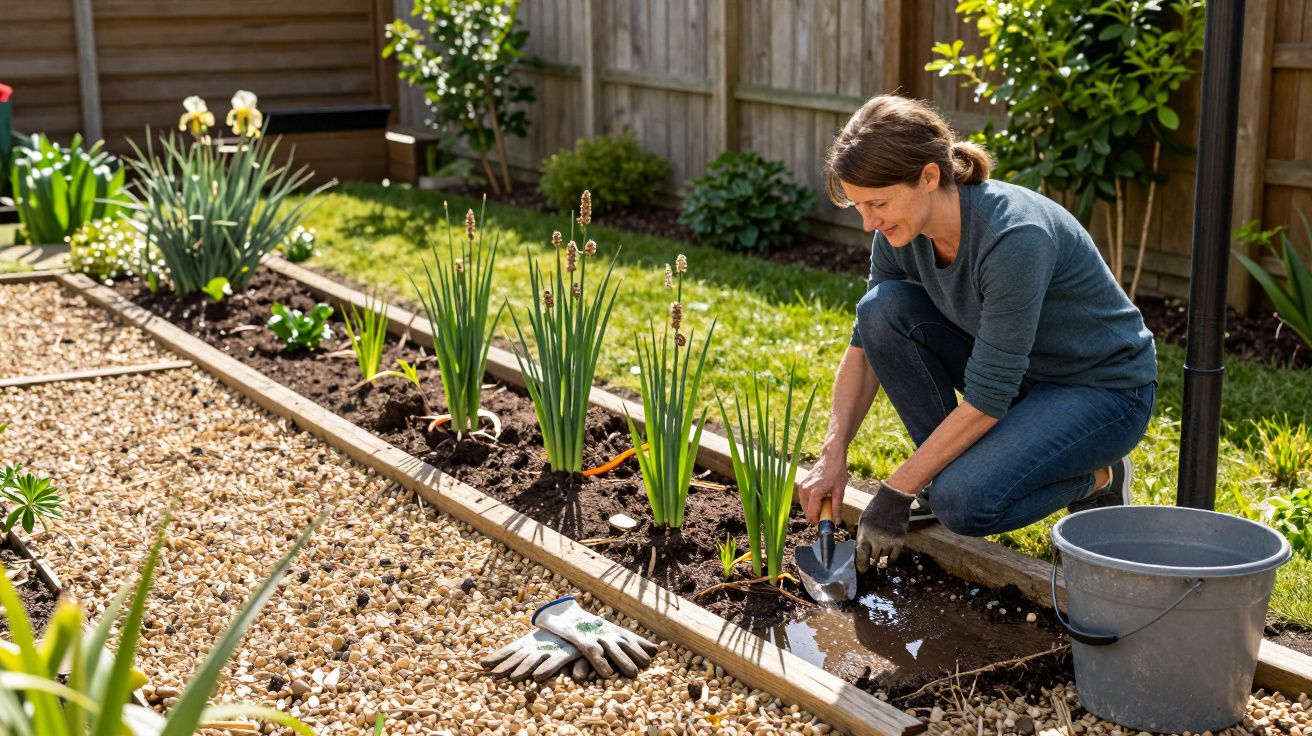
The doubt usually arrives with the first spadeful. You’ve chosen environmentally friendly garden design - fewer hard surfaces, more plants, more “letting nature do the work” - and suddenly it feels like you’re gambling with mud, mess and a garden that looks unfinished. Long-term ecological planning is what makes it make sense: the goal isn’t a perfect week-one makeover, it’s a garden that stabilises, self-manages and costs less to prop up over time.
In year one, it can look like you’ve done less, not more. In year three, it often looks like you knew exactly what you were doing.
Why this eco choice feels risky at the start
A conventional garden redesign gives you instant signals: sharp edges, clean paving lines, weed-free gravel and a tidy lawn that behaves on cue. Eco-led choices don’t reward you that quickly. They trade immediate “done-ness” for resilience.
The risky feeling usually comes from three things happening at once. The soil is being disturbed, the planting is still small, and you’re deliberately removing the safety nets (herbicides, heavy mulches of plastic, constant mowing) that kept everything looking controlled. For a few months, nature takes the mic.
The early stage looks like chaos because the system hasn’t closed its gaps yet.
What you’re really building (and why year three is the turning point)
Think of it less as landscaping and more as setting up a living system with feedback loops. By the third growing season, three boring-but-powerful things tend to be true:
- Roots have knitted the soil together. Water soaks in rather than skating across compacted ground.
- Plant canopy has thickened. Bare soil shrinks, which means fewer weed opportunities and less evaporation.
- Insects, birds and microbes have moved in. Pests get checked earlier, and organic matter breaks down where it falls.
That’s the moment the garden starts paying you back. Not in a dramatic “before and after” reel, but in fewer interventions that feel urgent. You stop firefighting and start tweaking.
The three-year timeline, without the fairy tale
You don’t need patience as a personality trait. You need to know what “normal” looks like while the garden settles.
Year one: the messy optimism phase
Everything is exposed. Rain splashes soil onto paths, seedlings vanish overnight, and the new meadow patch looks suspiciously like neglect. This is also when people panic-buy bark chippings and “just for now” weed killer.
What to aim for instead:
- Keep paths wide and obvious, even if planting is sparse.
- Use temporary edging (timber, bricks, even a spade-cut trench) to stop spread where you don’t want it.
- Mulch with compost, leaf mould or woodchip only where it’s genuinely useful, not as a blanket apology.
Year two: the negotiation phase
Plants put on bulk, but they also start competing. Some thrive, some sulk, and some turn out to be thugs. Wildlife appears in noticeable ways: aphids arrive, then ladybirds; slugs arrive, then frogs if you’ve given them cover.
Your job in year two is mostly editing:
- Thin anything that’s shading out everything else.
- Fill gaps with ground cover (geranium, ajuga, wild strawberry) rather than bare soil.
- Let “good mess” stay: seed heads, hollow stems, leaf litter under shrubs.
Year three: the “oh, that’s why” phase
This is when the system becomes legible. You’ll see stable plant communities forming, fewer blank patches, and clearer seasonal rhythm. Maintenance shifts from constant tidying to timed, predictable jobs.
Typical year-three wins:
- Watering drops because soil holds moisture.
- Weeding becomes lighter because the ground is occupied.
- Birds and beneficial insects become regulars, not occasional visitors.
The specific design choice that scares people most: ditching hard surfacing
Swapping large patios and sealed paving for permeable surfaces, planting and swales sounds virtuous. It also triggers a very British fear: “Will I just end up with mud?”
The trick is to replace hard surfacing with structure, not with hope. Permeable doesn’t mean soggy; it means water goes somewhere intentional.
A simple, low-drama setup:
- Permeable path: compacted MOT Type 1 base + gravel, or permeable pavers.
- Rain capture: a shallow swale or rain garden at the low point.
- Planting that earns its keep: sedges, iris, dogwood, moisture-tolerant perennials where water naturally collects.
Why it works: the first year is about routing water. The third year is about roots and soil biology finishing the job.
A practical checklist to get to year three without hating your garden
You don’t need more effort. You need fewer, better-timed moves.
- Autumn: add compost to beds; don’t dig unless you must. Mulch after the soil is wet, not bone dry.
- Spring: top up gaps with ground cover; stake and support early so plants don’t flop onto paths.
- Summer: water deeply but less often; leave some areas alone so predators (birds, beetles) can settle.
- Year-round: keep one “tidy anchor” (a clipped hedge, a neat path edge, a swept seating area). It makes the rest feel intentional.
One maintained line - a crisp edge or a clear path - buys you permission to let the ecology do the heavy lifting elsewhere.
The eco and cost angle (the bit you feel later)
Eco gardens can cost more up front if you’re investing in soil improvement, native hedging, trees, or good-quality permeable construction. The savings show up as reduced inputs: less watering, fewer replacements, fewer chemicals, and fewer “fix-it” projects after heavy rain.
Here’s the honest trade:
| Choice | Year-one feeling | Year-three reality |
|---|---|---|
| More planting, less paving | Untidy, “unfinished” | Cooler, greener, easier to manage |
| No-dig soil building | Slow change, weeds pop up | Better moisture, fewer problems |
| Rain garden/swale | Worry about soggy areas | Less runoff, fewer puddles |
Risks to watch (so the ‘risky’ part stays psychological)
Eco design fails when the basics are ignored, not because the idea is flawed.
- Don’t put a rain garden where water can’t drain at all (heavy clay may need an overflow route).
- Don’t rely on wildflower seed alone; prepare soil properly and accept you’ll edit for a couple of seasons.
- Don’t skip access. A wildlife-friendly border is lovely until you’re trampling through it to reach the shed.
- Don’t overplant tightly on day one. Crowding creates disease and disappointment; leave room for growth and filling-in.
If you want the “quiet win” version of eco design
Pick one area to go fully ecological, and keep the rest conventional while it settles. A rain garden by a downpipe, a 2–3 metre border rebuilt as no-dig, or a small meadow strip you mow twice a year can prove the concept without making the whole space feel like a gamble.
Once you’ve seen it tick through two seasons, year three doesn’t feel risky. It feels like relief.



Comments (0)
No comments yet. Be the first to comment!
Leave a Comment