Most people meet sustainable landscaping the way they meet composting: with a vague sense it’s “probably good”, and an immediate fear it will look scruffy. Environmentally conscious homeowners often care deeply about wildlife, water use and chemicals, but still flinch at the one choice that actually changes the impact of a garden: letting the lawn stop being the boss.
It’s not because they love mowing. It’s because lawns feel safe. A lawn looks like you’re coping.
The decision people resist: shrinking the lawn on purpose
Homeowners don’t usually reject sustainability outright. They reject the social risk.
A smaller lawn can read, to the wrong eyes, as “we gave up”, even when it’s deliberate, designed, and far more alive than a green rectangle. The resistance is emotional before it’s practical: What will it look like? What will the neighbours think? Where will the kids play?
The truth is simpler: in most UK gardens, the most resource-hungry area is also the least useful square metre for square metre.
The most sustainable square of turf is the one you don’t have to feed, mow, edge, water, or rescue from summer scorch.
Lawns aren’t evil. They’re just over-promoted
A bit of grass is brilliant. It cools the garden, gives you somewhere to sit, and it’s a soft landing for children and dogs.
The problem is the default assumption that the whole garden should be lawn, right up to fences and borders, like carpet. That’s where the waste creeps in: weekly mowing, petrol or electricity, fertiliser runoff, moss killer, endless edging, reseeding bare patches after drought, then watering to keep it “presentable”.
Meanwhile, the rest of the garden gets squeezed into a thin border that struggles to hold any real habitat. You end up maintaining a green desert and wondering why you don’t see many bees.
The quiet win: swapping turf for a “working” garden
When you reduce lawn, you don’t just remove a job. You create space for things that do jobs for you.
- Deep-planted beds hold moisture and reduce watering.
- Trees and shrubs give shade and cut heat stress on the garden (and sometimes the house).
- Ground cover plants outcompete weeds better than bare soil.
- Rain gardens and permeable surfaces handle downpours without puddles and runoff.
- Native and nectar-rich planting supports pollinators and birds that keep pests in check.
The garden becomes a small system rather than a weekly performance.
The move that makes it feel “tidy”: keep one clean edge
People don’t panic at wildness. They panic at ambiguity.
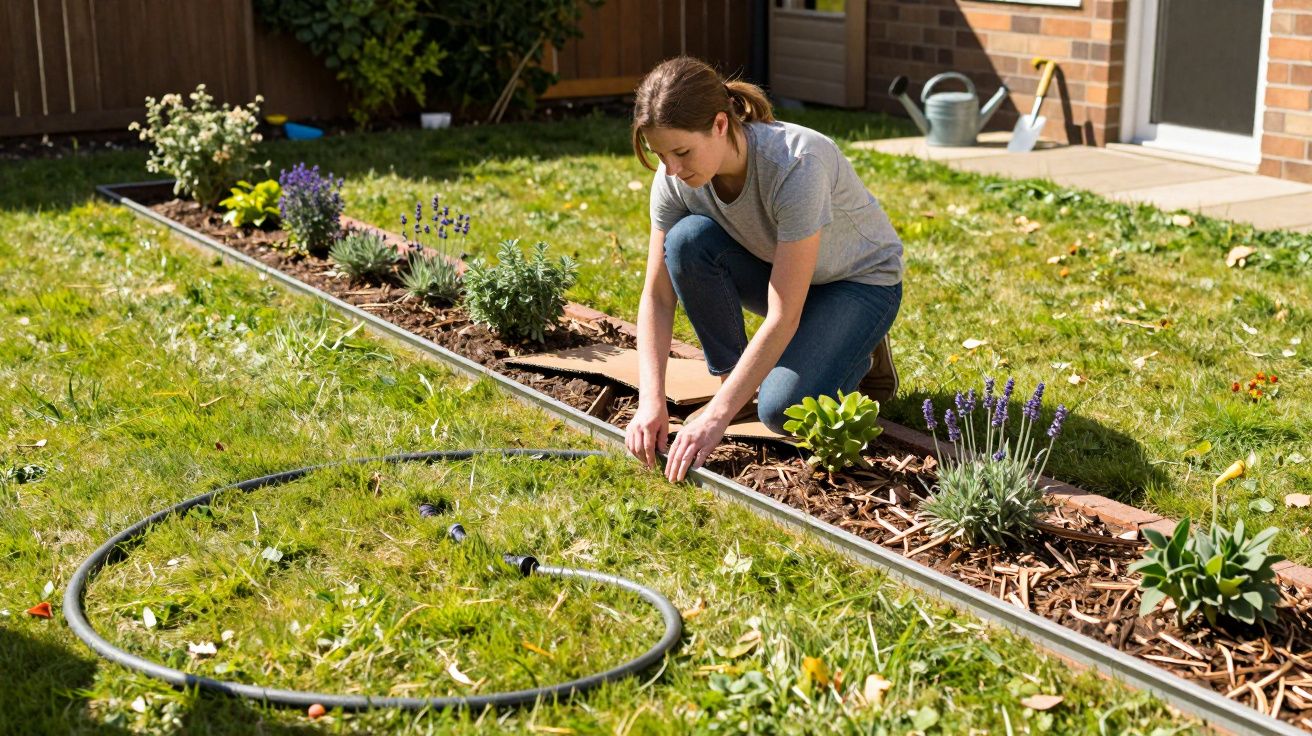
The easiest way to make a lower-lawn garden look intentional is to keep a clear boundary where lawn stops and planting begins. A crisp line signals design, not neglect.
Good “I meant to do this” edges:
- A narrow strip of gravel or hoggin
- Brick-on-edge or steel edging
- A mown path through longer planting
- Stepping stones with low ground cover between them
That one detail calms the whole look, even if the planting itself is looser and more wildlife-friendly.
A realistic compromise: keep the lawn you actually use
If you’re picturing a garden with nowhere to kick a ball, pause. This isn’t an all-or-nothing conversion.
A helpful rule is to keep grass where it serves a clear purpose, and retire it where it’s just tradition.
- Keep a single usable rectangle (for play, seating, drying laundry).
- Remove awkward strips: the shady side alley, the thin bit by the fence, the scorched patch by the patio.
- Turn high-traffic routes into paths, not mud-prone grass.
- Replace “problem turf” (mossy, boggy, baked) with something suited to the conditions.
Most gardens end up feeling bigger, not smaller, because the space is defined.
How to do it without creating a weed festival
The fear is valid: tear out grass, blink, and you’ve got bindweed throwing a house party.
You avoid that by timing and layering, not by heroics.
- Mark the new lawn shape with a hosepipe or string. Live with it for a week.
- Remove turf (lift it, compost it if clean, or stack it grass-to-grass to rot).
- Add a weed-suppressing layer: thick cardboard (no glossy print), overlapping well.
- Top with 8–10 cm of compost + mulch or a no-dig bed mix.
- Plant densely: the soil should not be “visible” for long.
Dense planting is the underrated trick. Bare soil invites weeds; plant cover prevents them.
What to plant if you want low effort and high impact
You don’t need a rare wildflower meadow to be sustainable. You need plants that suit your light, soil, and the amount of time you realistically have.
Solid, forgiving options for many UK gardens:
- Dry, sunny spots: lavender, thyme, salvias, nepeta (catmint), sedums
- Shady areas: ferns, hellebores, hardy geraniums, sarcococca, ivy as ground cover away from walls
- Pollinator staples: single-flowered roses, oregano/marjoram, verbena bonariensis, echinacea
- Weed-smothering ground cover: creeping thyme, ajuga, vinca, hardy geranium ‘Rozanne’
Aim for a mix of early, mid, and late flowers so insects aren’t fed for two weeks and then abandoned.
The mindset shift that makes it stick
The hardest part of sustainable landscaping isn’t the spade work. It’s letting go of the idea that “neat” equals “good”.
A garden can look cared for without being uniformly clipped. It can have seed heads in winter. Leaves can stay under shrubs. Clover in the remaining lawn can be a feature, not a failure. Once you stop treating every non-grass plant as an invader, maintenance drops sharply.
And oddly, pride goes up. You start noticing life.
A 20-minute experiment before you commit
If you’re still unsure, run a small test that doesn’t feel irreversible.
- Pick one strip of lawn you don’t use (often along a fence).
- Convert just that area into a bed with cardboard + compost.
- Plant five tough perennials and a ground cover.
- Add one clean edge so it looks finished.
Give it eight weeks. If you like the feel of it-and the reduction in mowing-you’ll know what to do next.
FAQ:
- Will a smaller lawn make the garden look messy? Not if you keep a clear edge and plant densely. “Messy” usually comes from bare soil and undefined borders, not from more plants.
- Is clover a good alternative to grass? Often, yes. It stays greener in dry spells, feeds pollinators when it flowers, and can reduce the need for nitrogen fertiliser, especially in mixed lawns.
- Do I need to stop using all chemicals to be “sustainable”? Not necessarily, but the big win is reducing routine inputs. Less lawn usually means less need for fertilisers, weedkillers, and pesticide sprays because the garden is more balanced.
- What if I sell the house-do buyers want lawns? Many still do, which is why keeping one usable patch of grass is a smart compromise. A designed, well-edged planted area can read as “low maintenance” rather than “high risk.”




Comments (0)
No comments yet. Be the first to comment!
Leave a Comment