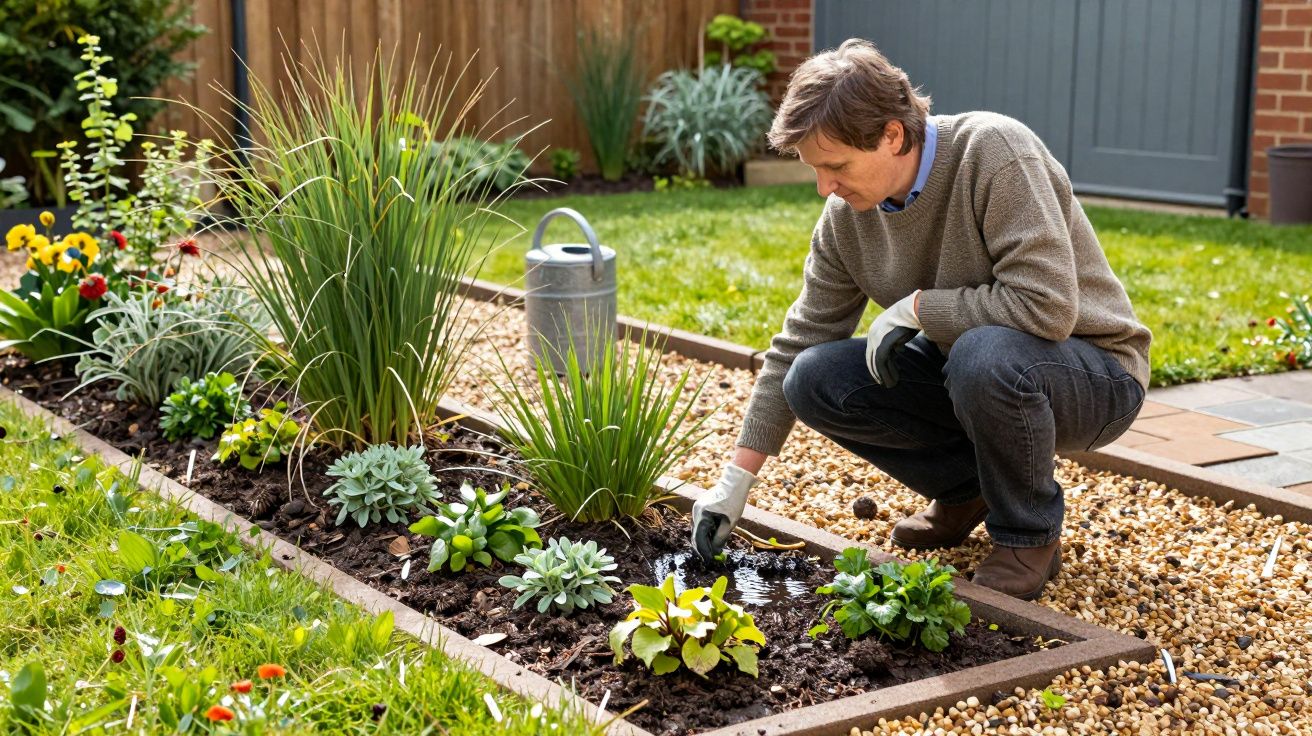
The first time you notice it, it’s usually after rain: water sitting in the low spots, a soft mess where the lawn used to behave, a clump of self-seeded flowers thriving exactly where you didn’t “plan” them. Eco-friendly garden design and natural landscape design both treat that moment as information, not failure-and that’s why it matters to you. In a warming, wetter, less predictable Britain, the old promise of perfect symmetry often costs more time, water, chemicals, and disappointment than it returns.
There’s a principle quietly replacing the clipped mirror-image border: design with gradients, not straight lines. Think of your garden less as a formal room, more as an ecosystem with transitions-dry to damp, sunny to shady, short to tall-so plants and wildlife can find their niche without constant correction.
The day symmetry stops looking “tidy” and starts looking expensive
Traditional garden symmetry is a bargain you keep renegotiating. Straight edges need edging. Matching beds need matching soil conditions. Lawns want uniform light and drainage that your plot rarely provides, especially if it slopes, sits over clay, or is hemmed in by buildings.
The hidden cost isn’t just money. It’s attention. You spend weekends forcing one side to behave like the other, when one side is always a little hotter, a little windier, a little damper. Nature notices; your design pretends not to.
A gradient-based approach flips the job. Instead of fighting microclimates, you map them and let them structure the garden. The symmetry you lose in shapes, you regain in stability.
The eco design principle: create “soft transitions” that match how nature actually works
A gradient is simply a gradual change. In gardens, it’s the move from one condition to another without abrupt borders: damp to dry, open to sheltered, nutrient-rich to lean. The principle is to design those transitions on purpose, because transitions are where resilience lives.
In practice, it looks like this:
- A small rain garden that blends into a drier meadow strip, rather than a drain that disappears underground.
- A hedge edge that fades into shrubs, then into perennials, rather than hedge → lawn → bed with a hard line.
- A shaded woodland corner that becomes a semi-shade “buffer” planting before you hit full sun.
If you’ve ever watched which parts of your garden stay green in a heatwave, you already have the first draft. Gradients take that observation and turn it into layout.
How to build a gradient garden without redesigning everything
You don’t need to rip out your paving or abandon structure. You just stop demanding that every square metre performs the same job, and you give each area a role that suits its conditions.
Start with a slow audit. One walk, one notebook, one cup of tea afterwards.
- Water: where does it pool, run, or vanish quickly?
- Light: which spots get morning sun, harsh afternoon sun, or none at all?
- Wind: where do plants lean, dry out, or get battered?
- Soil: where is it thin, compacted, or always sticky?
Then choose one “spine” gradient to build around-usually water, because it decides so much else. A downpipe, a low patch, a swale, the part near a shed where drip lines form: these are free clues.
A simple first upgrade that works in many UK gardens:
- Capture water (water butt, shallow basin, or rain garden pocket).
- Plant moisture-lovers closest to the capture point.
- Blend outward into drought-tolerant plants as the soil gets drier.
- Finish with a tougher edge (gravel strip, native hedge line, or mulched path) that can take foot traffic and dry spells.
It’s not a “wild” look by default. It’s a functional look that can be as neat as you like-just not rigid.
Planting like an ecosystem: the quiet power of layers
Symmetry usually flattens a garden: the same height, the same rhythm, repeated. Gradients add layers, and layers do the work that chemicals used to do. They shade soil, slow evaporation, buffer wind, and give insects shelter across seasons.
Aim for three layers wherever you can:
- Ground layer: groundcover, bulbs, low grasses to protect soil.
- Middle layer: perennials and small shrubs for long bloom and habitat.
- Upper layer: taller shrubs, climbers, or small trees for structure and microclimate.
This is where eco-friendly garden design stops being a moral badge and becomes a comfort upgrade. A layered garden is cooler in summer, less water-hungry, and less prone to that brittle “nothing’s coping” look when weather swings.
The “tidy enough” trick: boundaries you keep, borders you soften
The fear is always the same: if you drop symmetry, the garden will look like you’ve given up. The fix is to keep clear human cues while letting planting be more ecological.
Choose two or three cues and repeat them:
- A mown or gravel path you can follow without thinking.
- One consistent edging material (brick, steel, timber) used sparingly.
- A clipped hedge or a single formal shrub “anchor” near the house.
- Mulch that reads as intentional, not neglected.
The planting inside those cues can be looser, more responsive. You can have a soft meadow patch and still have a crisp route through it. You can have a rain garden and still have a neat seating area next to it.
The goal isn’t to make the garden “wild”. It’s to make it self-correcting.
A quick checklist to replace the symmetry mindset
When you’re tempted to mirror, ask different questions:
- What condition is this spot already good at?
- What transition does it sit inside (wet-to-dry, shade-to-sun)?
- Can I plant for the condition instead of altering the condition?
- Where do I want neatness-paths, seating, entrances-and where can I let nature do the filling-in?
If you do nothing else this month, do this: stop trying to make the damp corner behave like the dry one. Make the damp corner useful.
The gradient approach in one glance
| Garden problem | Symmetry response | Gradient response |
|---|---|---|
| One side dries out fast | More watering, lawn repair | Drought-tolerant strip, mulch, gravel edge |
| Low spot floods | Drain it away | Rain garden pocket, moisture plants, overflow route |
| Shade under tree | Thin lawn, constant reseeding | Woodland planting + semi-shade transition |
FAQ:
- Is this just another way of saying “rewilding”? Not necessarily. Gradients can look very tidy; the principle is ecological fit and softer transitions, not mess.
- Will a gradient garden attract more pests? It usually attracts more predators (birds, hoverflies, beetles) too, which helps balance aphids and other common problems.
- What’s the quickest win for a small UK garden? Treat water as a design feature: add a water butt, create a damp-to-dry planting strip, and mulch heavily to stabilise moisture.
- Do I have to use only native plants? No. Native plants are often excellent for wildlife, but the bigger win is matching plants to conditions so they thrive with fewer inputs.
- How do I stop it looking untidy in winter? Keep structural cues (paths, edging, one evergreen anchor) and leave seedheads selectively-cut back what flops into walkways, not everything.




Comments (0)
No comments yet. Be the first to comment!
Leave a Comment