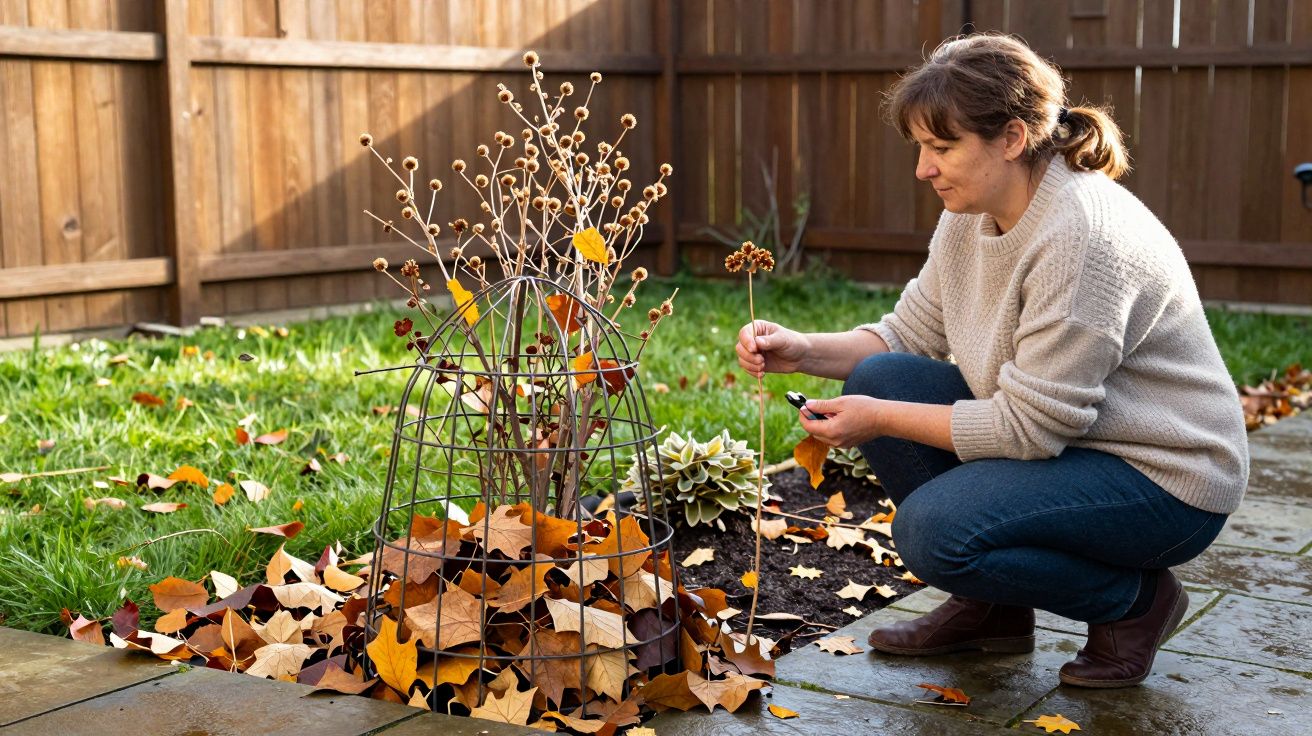
The first cold snap arrives and the garden looks “done”: seed heads browned, borders slack, the lawn a little sulky. Sustainable landscaping asks you to pause before you tidy, because seasonal biodiversity cycles don’t run on our deadlines. What looks like failure in November can be shelter, food, and next spring’s momentum-if you let it stand.
There’s a particular itch that comes with autumn: clear the beds, cut everything back, make the place look cared for. It’s a tidy feeling, and it photographs well. But eco gardens keep poking holes in that idea of seasonal completion, the way a robin pecks at compost: not to ruin it, to make it useful.
You notice it when you stop “finishing” the garden and start watching it. The dead stalk you were about to shear off is a ladder for a ladybird, the leaf pile is a hedgehog’s duvet, the seed heads are a buffet you didn’t mean to serve. The garden is not completed; it’s between chapters.
Why “finished” gardens often work against nature
The classic end-of-season reset assumes winter is a void, a pause button. In reality, winter is when a lot of the work gets done quietly: overwintering insects in hollow stems, fungi knitting soil together, birds working their routes. When we strip everything back to bare soil and clipped edges, we’re not just changing the look-we’re interrupting the handover.
It’s the same mistake people make with a kitchen hob: thinking force and shine equals clean, when the best results come from understanding how the surface behaves. In eco gardens, the “surface” is habitat. Abrasion looks productive, but it often removes the very structure that makes the system resilient.
The irony is that the tidy garden can become the higher-maintenance garden. Exposed soil crusts, weeds rush in, moisture evaporates, and you end up chasing problems you created with a rake. Let the garden keep some of its scaffolding and it does a chunk of the job for you.
The eco-garden shift: manage transitions, not endpoints
Here’s the mindset change that makes sustainable landscaping feel less like a moral project and more like relief: you don’t have to complete the season. You just have to help the garden transition.
That transition has three big levers-structure, food, and refuge-and none of them require expensive kit.
- Structure: leave stems, seed heads, and some standing plant matter until spring warmth returns.
- Food: keep seeds and berries available; avoid winter “clean-outs” that remove forage.
- Refuge: protect overwintering spots-leaf litter, log piles, tussocky grasses, gaps under shrubs.
This is not neglect. It’s timing. You’re choosing when to intervene so you’re not constantly undoing your own work.
A simple method for “untidy on purpose” (without it looking abandoned)
Start with a walk around on a dry day and make three small decisions. First, pick one area that can look a bit wild without bothering you-behind a shed, under a hedge, the far end of a border. Second, decide where you do want crispness-usually a path edge, a doorstep view, a seating spot. Third, draw the line between the two with something intentional: a mown strip, a mulch edge, a low border.
That boundary is the trick people forget. Wildlife doesn’t need your garden to be messy everywhere; it needs pockets that stay put through winter. Humans, meanwhile, need the visual cue that the mess is chosen.
Try this as a quick plan:
- Leave: hollow stems (teasels, fennel, raspberries), seed heads (echinacea, sedum), grasses.
- Cut back: anything flopping onto paths, anything diseased, and anything that will rot into a crown.
- Pile: leaves in one or two contained drifts, tucked behind shrubs or inside a simple wire circle.
- Mulch: bare soil lightly, but don’t smother everything; leave some leaf litter where it can sit.
Common pitfalls are predictable. Cutting everything to the same height is the big one-it removes variety, and variety is habitat. Another is “mulch panic”: piling thick mulch everywhere can bury ground-nesting bees’ access points and reduce the natural leaf layer that soils evolved with. Keep it light and site-specific.
What seasonal biodiversity cycles actually look like in a garden
It’s tempting to think biodiversity is a spring-and-summer show: flowers, bees, butterflies, done. But seasonal biodiversity cycles are more like a relay than a fireworks display. One stage sets up the next.
In late summer, seed heads form and stems harden; in autumn, leaves drop and cover the soil; in winter, animals and insects tuck into the structure you left behind; in early spring, birds pull fibres and insects wake into a garden that already has hiding places. By the time you feel the urge to “start again”, the garden has already started.
If you want one small proof, do this: on a mild winter day, gently tap a dried stem over a dark tray. If you see nothing, you still learned something. If you see tiny lives drop out-spiders, beetles, sleeping larvae-you’ll stop thinking of dead plants as dead.
“A garden doesn’t end at the first frost,” a local grower once told me. “It just goes underground and into the stems.”
The spring clean that doesn’t erase winter’s work
There is a moment to cut back, and it’s not a fixed date. Wait for signs: consistent warmth, active insects, birds carrying nesting material, new shoots pushing up. Then cut back in stages, not all at once, so refuge doesn’t disappear overnight.
A gentle spring routine looks like this:
- Snip stems into short lengths and drop them into a tucked corner as habitat rather than binning them.
- Rake lightly only where you need sowing space; elsewhere, leave some leaf litter to finish breaking down.
- Keep “clean” areas clean-paths, seating, entrances-so the garden feels welcoming even as it stays ecologically useful.
The point isn’t to make your garden look like a nature reserve. It’s to let it behave like a living system while still being a place you want to step into with a mug of tea.
| Shift | What you do | Why it matters |
|---|---|---|
| From “cut back” to “hold back” | Leave stems and seed heads till spring | Protects overwintering insects and feeds birds |
| From “clear” to “contain” | Pile leaves deliberately, edge wild zones | Keeps habitat without the abandoned look |
| From “reset” to “stagger” | Do spring tidy-up in phases | Avoids wiping out refuge in one go |
FAQ:
- Do I have to leave everything standing all winter? No. Leave enough structure for habitat, but cut back anything blocking paths, rotting into crowns, or showing disease.
- Won’t an eco garden look messy? It can, unless you add clear boundaries: mown edges, mulch lines, and tidy “view corridors” near doors and seating.
- What’s the easiest high-impact change? Stop removing all leaves. Contain them in drifts or a simple leaf cage and let them break down slowly.
- When is it safe to do the spring cut-back? When days are consistently mild and you see regular insect activity. Do it gradually so seasonal biodiversity cycles aren’t interrupted in a single weekend.
- Is this compatible with a small urban garden? Yes. Even one log pile in a pot corner, a strip of unmown grass, or a few standing stems can carry a surprising amount of life through winter.





Comments (0)
No comments yet. Be the first to comment!
Leave a Comment