I used to think a “good” garden was one that stayed put: crisp edges, obedient plants, no surprises. Then I watched environmentally friendly garden design in action - not as a look, but as a way of using your space - and realised habitat creation is the point, not a side benefit. It matters because the more we try to control everything outdoors, the less resilient (and frankly, the less alive) our gardens become.
The shift starts with a small discomfort: letting your garden have intentions of its own. A leaf gets nibbled. A seedling appears where you didn’t plant it. The birds arrive before you’ve “finished”.
The mistake eco-friendly gardens refuse to make
Control feels tidy. Control also breaks easily.
Eco-friendly gardens don’t aim for a perfect picture; they aim for a functioning system. Instead of asking, “How do I stop this happening?”, they ask, “What is this telling me my garden needs?” That one question changes everything: pest problems become food-chain gaps, soggy corners become wetland opportunities, and “mess” becomes cover, nesting, and overwintering sites.
There’s a particular relief in it. You still intervene - you’re not abandoning the place - but you stop trying to win an unwinnable war against weather, insects, birds, and time.
What “less control” actually looks like in practice
Think of it as steering rather than commanding. You design the conditions, then you let life do the filling-in.
A few high-leverage moves do most of the work:
- Choose structure over fuss: a couple of small trees, a mixed shrub layer, and long-flowering perennials beat a flat lawn-and-bedding scheme for stability.
- Use borders as buffers: slightly wider edges (even 30–60 cm) catch wind, hold moisture, and give insects somewhere to disappear when you walk past.
- Let some plants finish their story: seedheads, hollow stems, and leaf litter aren’t laziness; they’re winter hotels.
- Accept a “working” level of damage: a few chewed leaves often means you’ve got caterpillars, which means you’ll likely get birds.
It’s not about going wild everywhere. It’s about choosing where to be strict - paths, seating, access - and where to be generous.
Habitat creation: build a garden that feeds something besides your eyes
Habitat creation sounds grand, but it’s mostly made of small, repeatable gestures. You’re adding places to hide, to drink, to breed, and to overwinter - and you’re doing it in a way that doesn’t require constant correction.
Start with the basics: food, water, shelter.
- Food: flowers across seasons (early spring to late autumn), plus some berries or seedheads left standing.
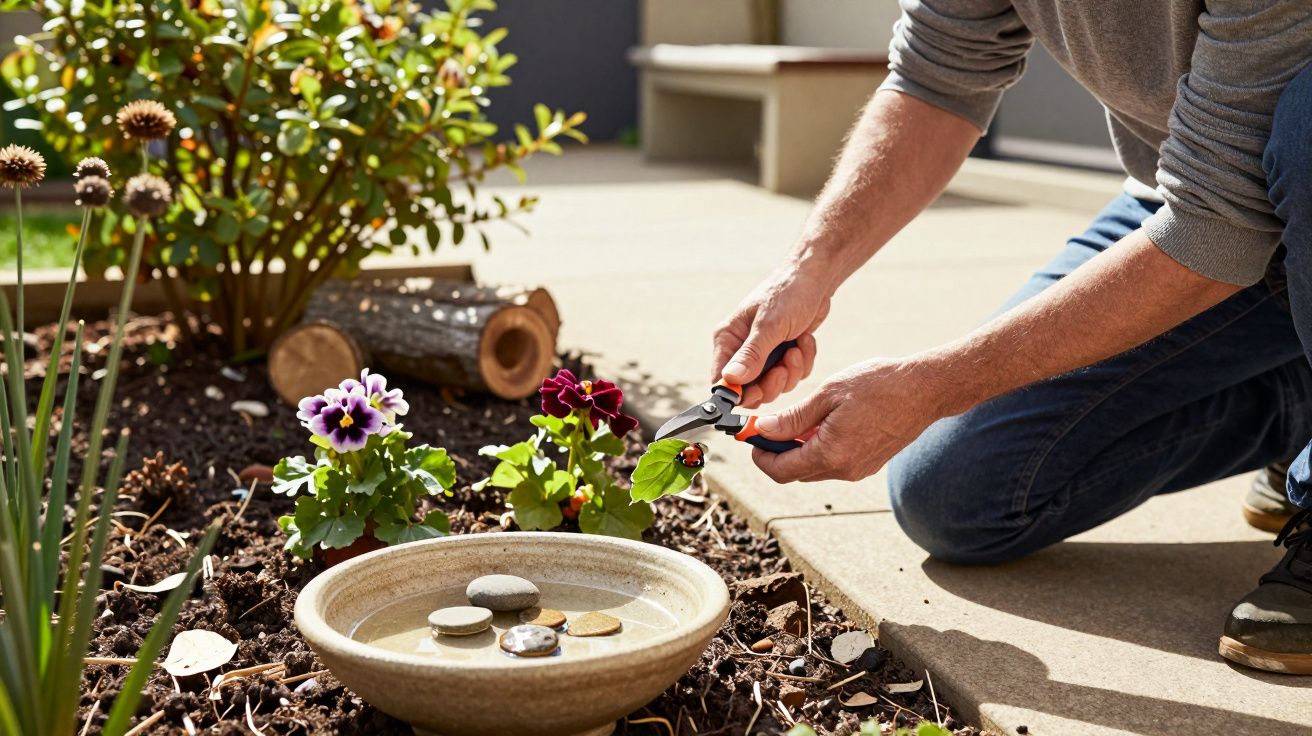
- Water: a shallow dish with stones, or a tiny pond; refresh in hot spells.
- Shelter: dense shrubs, log piles, long grass in a corner, climbers on a fence.
Then you connect the dots. A pond is better near planting. A log pile works better half-shaded. A hedge becomes a corridor rather than a wall. The garden stops being a display and starts being a neighbourhood.
The quiet mechanics behind a resilient garden
A controlled garden relies on you. A resilient garden relies on relationships.
When you diversify planting, you diversify timing: different roots at different depths, different flowers opening at different weeks, different insects turning up to match. When you leave leaf litter under shrubs, you’re not just “mulching”; you’re protecting soil life from temperature swings and feeding fungi that keep nutrients cycling.
And when you stop sterilising every surface, you allow predators to move in. Ladybirds, lacewings, hoverflies, frogs, hedgehogs - they don’t arrive because you bought them. They arrive because you built a place that makes sense.
Let’s be honest: the hardest part is psychological. You have to get comfortable with the garden looking like it’s doing something when you’re not watching.
A simple way to redesign your garden without ripping it out
Try this: keep your current layout, but change your rules.
Pick one small area - a border, a back corner, a strip along a fence - and run a “less control” experiment for a season.
- Stop edging it weekly. Edge it once, then let it soften.
- Plant in threes and fives. Repetition reads as intentional, even when things self-seed.
- Add one habitat feature. Log pile, water dish, or a native shrub.
- Pause chemical inputs. No broad-spectrum insecticides; go targeted only if a plant is genuinely failing.
- Keep notes like a scientist. What flowers first, what gets eaten, what turns up anyway.
You’ll notice something: when you give nature one usable corner, it starts solving problems in the rest of the garden too.
A “control-light” checklist that still keeps the place liveable
Eco-friendly doesn’t mean neglected. It means your effort goes where it matters.
- Control paths and thresholds: clear access, safe steps, visibility near doors.
- Control invasives early: pull or cut before they seed; don’t wait for a “tidy weekend”.
- Control water direction: rain gardens, swales, mulches - stop runoff before it erodes soil.
- Control nutrient leaks: compost well, mulch, feed the soil instead of forcing quick top growth.
Everything else can be a little looser. You’re not lowering standards; you’re changing what the standard is.
| Shift | What you do | What you get |
|---|---|---|
| From tidying to timing | Leave seedheads, cut back later | Winter cover and spring food |
| From spraying to observing | Identify the cause, support predators | Fewer recurring outbreaks |
| From flat lawn to layered planting | Add shrubs, perennials, groundcover | Cooler soil and more wildlife |
FAQ:
- Can environmentally friendly garden design still look “neat”? Yes. Keep strong lines in hard landscaping and repeat plant groups; let the planting within those lines be more natural.
- Won’t habitat creation attract pests? It attracts life, including predators that reduce pest spikes. The aim is balance, not zero insects.
- Do I need a pond to make a difference? No. A water dish, dense shrubs, and a log pile already create useful habitat.
- What’s the quickest win for a small garden? Plant for long flowering (spring to autumn) and stop over-tidying one corner; insects respond fast, and birds follow.
- How do I know if I’m being “too hands-off”? If paths become unusable, invasives spread, or plants are failing repeatedly, step in. “Less control” is still active management - just smarter.




Comments (0)
No comments yet. Be the first to comment!
Leave a Comment